
White Paper on Office automation
COURTESY :- vrindawan.in
Wikipedia
Office automation refers to the varied computer machinery and software used to digitally create, collect, store, manipulate, and relay office information needed for accomplishing basic tasks. Raw data storage, electronic transfer, and the management of electronic business information comprise the basic activities of an office automation system. Office automation helps in optimizing or automating existing office procedures.
The backbone of office automation is a local area network, which allows users to transfer data, mail and voice across the network. All office functions, including dictation, typing, filing, copying, fax, telex, microfilm and records management, telephone and telephone switchboard operations, fall into this category. Office automation was a popular term in the 1970s and 1980s as the desktop computer exploded onto the scene. Advantages of office automation include that it can get many tasks accomplished faster, it eliminates the need for a large staff, less storage is required to store data, and multiple people can update data simultaneously in the event of changes in schedule.
Businesses can easily purchase and stock their wares with the aid of technology. Many of the manual tasks that used to be done by hand can now be done through hand held devices and UPC and SKU coding. In the retail setting, automation also increases choice. Customers can easily process their payments through automated credit card machines and no longer have to wait in line for an employee to process and manually type in the credit card numbers.
Office payrolls have been automated, which means no one has to manually cut checks, and those checks that are cut can be printed through computer programs. Direct deposit can be automatically set up and this further reduces the manual process, and most employees who participate in direct deposit often find their paychecks come earlier than if they’d have to wait for their checks to be written and then cleared by the bank.
Other ways automation has reduced employee manpower on tasks is automated voice direction. Through the use of prompts, automated phone menus and directed calls, the need for employees to be dedicated to answer the phones has been reduced, and in some cases, eliminated.
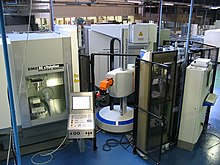
Automation describes a wide range of technologies that reduce human intervention in processes, namely by predetermining decision criteria, sub process relationships, and related actions, as well as embodying those predetermination in machines. Automation has been achieved by various means including mechanical, hydraulic, pneumatic, electrical, electronic devices, and computers, usually in combination. Complicated systems, such as modern factories, airplanes, and ships typically use combinations of all of these techniques. The benefit of automation includes labor savings, reducing waste, savings in electricity costs, savings in material costs, and improvements to quality, accuracy, and precision.
Automation includes the use of various equipment and control systems such as machinery, processes in factories, boilers, and heat-treating ovens, switching on telephone networks, steering, and stabilization of ships, aircraft, and other applications and vehicles with reduced human intervention. Examples range from a household thermostat controlling a boiler to a large industrial control system with tens of thousands of input measurements and output control signals. Automation has also found space in the banking sector. In control complexity, it can range from simple on-off control to multi-variable high-level algorithms.
In the simplest type of an automatic control loop, a controller compares a measured value of a process with a desired set value and processes the resulting error signal to change some input to the process, in such a way that the process stays at its set point despite disturbances. This closed-loop control is an application of negative feedback to a system. The mathematical basis of control theory was begun in the 18th century and advanced rapidly in the 20th. The term automation, inspired by the earlier word automatic (coming from automaton), was not widely used before 1947, when Ford established an automation department. It was during this time that industry was rapidly adopting feedback controllers, which were introduced in the 1930s.
The World Bank’s World Development Report of 2019 shows evidence that the new industries and jobs in the technology sector outweigh the economic effects of workers being displaced by automation. Job losses and downward mobility blamed on automation have been cited as one of many factors in the resurgence of nationalist, protectionist and populist politics in the US, UK and France, among other countries since the 2010s.
In open-loop control, the control action from the controller is independent of the “process output” (or “controlled process variable”). A good example of this is a central heating boiler controlled only by a timer, so that heat is applied for a constant time, regardless of the temperature of the building. (The control action is switching the boiler off and on. The process output is building temperature.)
In closed-loop control, the control action from the controller is dependent on the process output. In the case of the boiler analogy, this would include a temperature sensor to monitor the building temperature, and thereby feed a signal back to the controller to ensure it maintains the building at the temperature set on the thermostat. A closed-loop controller, therefore, has a feedback loop that ensures the controller exerts a control action to give a process output equal to the “reference input” or “set point”. For this reason, closed-loop control is also called feedback control.
The definition of a closed-loop control system according to the British Standard Institution is ‘a control system possessing monitoring feedback, the deviation signal formed as a result of this feedback being used to control the action of a final control element in such a way as to tend to reduce the deviation to zero.’
Likewise, a feedback control system is a system that tends to maintain a prescribed relationship of one system variable to another by comparing functions of these variables and using the difference as a means of control. The advanced type of automation that revolutionized manufacturing, aircraft, communications, and other industries, is feedback control, which is usually continuous and involves taking measurements using a sensor and making calculated adjustments to keep the measured variable within a set range. The theoretical basis of closed-loop automation is control theory.