
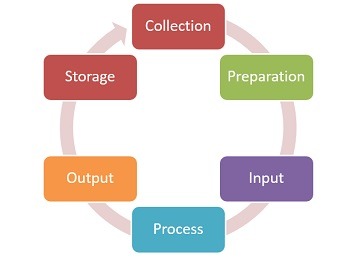
Concept of Data Processing
Data Processing: A Fundamental Concept
1. Definition: Data processing is a series of operations performed on data to convert it into meaningful information. It involves the collection, manipulation, and interpretation of raw facts and figures to derive insights, support decision-making, and facilitate various applications.
2. Components of Data Processing:
- Data Collection:
- The process of gathering raw data from various sources, such as sensors, forms, or databases.
- Data Entry:
- Inputting collected data into a system for processing. This can be manual or automated.
- Data Storage:
- Storing data in databases, data warehouses, or other storage systems for future retrieval and analysis.
- Data Processing:
- Manipulating and transforming raw data into a more useful and meaningful format. This can involve calculations, sorting, filtering, and other operations.
- Data Analysis:
- Examining processed data to discover patterns, trends, and insights. This step often involves statistical methods, machine learning, or other analytical techniques.
- Data Output:
- Presenting the processed information in a format that is understandable and usable. Outputs may include reports, visualizations, or alerts.
3. Types of Data Processing:
- Batch Processing:
- Processing data in large volumes at scheduled intervals. Common in tasks like payroll processing and end-of-day reporting.
- Real-time Processing:
- Immediate processing of data as it is generated. Used in scenarios where instant responses are critical, such as financial transactions.
- Online Transaction Processing (OLTP):
- Processing transactions in real-time, often involving a large number of short, simple transactions.
- Online Analytical Processing (OLAP):
- Analyzing data interactively to provide insights. Commonly used for business intelligence and decision support.
4. Importance of Data Processing:
- Informed Decision-Making:
- Processed data provides the basis for informed decision-making, enabling individuals and organizations to make choices backed by insights.
- Automation and Efficiency:
- Automation of data processing tasks increases efficiency and reduces the likelihood of errors associated with manual processing.
- Insight Generation:
- Data processing transforms raw data into actionable insights, helping identify trends, opportunities, and potential risks.
- Improved Communication:
- Processed data is presented in a clear and understandable format, facilitating communication and understanding among stakeholders.
5. Challenges in Data Processing:
- Data Quality:
- Ensuring the accuracy and reliability of the data being processed.
- Data Security:
- Protecting data during processing to prevent unauthorized access or manipulation.
- Scalability:
- Handling an increasing volume of data efficiently as an organization grows.
- Real-time Processing Complexity:
- Managing the complexity of processing data in real-time, especially in dynamic environments.
6. Future Trends:
- Big Data Processing:
- Dealing with massive volumes of data, often in real-time, to extract valuable insights.
- Edge Computing:
- Processing data closer to the source, reducing latency and enhancing real-time processing capabilities.
- Artificial Intelligence (AI) Integration:
- Leveraging AI algorithms for more advanced and automated data processing tasks.
- Blockchain Technology:
- Ensuring secure and transparent data processing through decentralized and tamper-resistant ledgers.
7. Conclusion: Data processing is at the core of harnessing the power of information in today’s data-driven world. Whether for business intelligence, scientific research, or everyday decision-making, effective data processing transforms raw data into knowledge, providing a foundation for progress and innovation.
The concept of data processing encompasses several key requirements to effectively manage and derive value from raw data. These requirements span various stages of the data processing lifecycle:
- Data Collection:
- Requirement: A mechanism for gathering raw data from diverse sources.
- Rationale: Accurate and comprehensive data collection is crucial for the subsequent stages of processing.
- Data Entry:
- Requirement: Reliable methods for entering collected data into a system.
- Rationale: Accurate data entry ensures the integrity of the information being processed.
- Data Storage:
- Requirement: Adequate storage infrastructure for housing data securely.
- Rationale: Efficient data storage is essential for easy retrieval, analysis, and management of information.
- Data Processing:
- Requirement: Processing tools and algorithms to manipulate and transform raw data.
- Rationale: Effective processing is necessary for converting raw data into meaningful insights.
- Data Analysis:
- Requirement: Analytical tools and techniques to extract patterns and trends.
- Rationale: Analysis provides valuable insights for decision-making and problem-solving.
- Data Output:
- Requirement: Mechanisms for presenting processed information in a usable format.
- Rationale: Clear and accessible output is essential for effective communication and decision support.
- Data Quality Assurance:
- Requirement: Processes and measures to ensure the accuracy and reliability of data.
- Rationale: High-quality data is critical for trustworthy results and informed decision-making.
- Data Security:
- Requirement: Security protocols to safeguard data during processing.
- Rationale: Protection against unauthorized access and data breaches is essential for maintaining data integrity and user trust.
- Scalability:
- Requirement: Infrastructure and systems that can handle increasing volumes of data.
- Rationale: As data grows, scalable solutions ensure continued efficiency and performance.
- Real-time Processing Capability:
- Requirement: Systems capable of processing data in real-time.
- Rationale: Real-time processing is crucial for applications that demand immediate responses, such as financial transactions or monitoring systems.
- User-Friendly Interfaces:
- Requirement: Intuitive interfaces for users to interact with data and processing tools.
- Rationale: User-friendly interfaces enhance accessibility and usability, empowering users to leverage the benefits of data processing.
- Compliance with Regulations:
- Requirement: Adherence to data protection and privacy regulations.
- Rationale: Ensuring compliance with regulations is essential to avoid legal implications and protect individuals’ privacy.
- Continuous Improvement:
- Requirement: Processes for ongoing monitoring, evaluation, and improvement.
- Rationale: Continuous improvement ensures that data processing methods stay effective and aligned with evolving needs.
- Integration with Emerging Technologies:
- Requirement: Adaptability to integrate with emerging technologies such as artificial intelligence or blockchain.
- Rationale: Staying abreast of technological advancements ensures the relevancy and competitiveness of data processing systems.
Understanding and addressing these requirements is fundamental to implementing a robust and effective data processing system that meets the demands of today’s data-driven landscape.
The concept of data processing involves the collaboration of various individuals and roles throughout the stages of collecting, managing, and deriving insights from data. Here are key individuals or roles required for effective data processing:
- Data Analysts:
- Role: Responsible for analyzing and interpreting data to extract meaningful insights. They use statistical methods, data visualization tools, and analytical techniques to uncover patterns and trends.
- Data Scientists:
- Role: Professionals with expertise in advanced analytics, machine learning, and statistical modeling. They develop algorithms and models to gain deeper insights from data, often working with large and complex datasets.
- Data Engineers:
- Role: Involved in the design and construction of data architecture, databases, and processing systems. Data engineers ensure the infrastructure is capable of handling data efficiently and securely.
- Database Administrators (DBAs):
- Role: Responsible for managing and maintaining databases that store and organize the data. They optimize database performance, ensure data integrity, and implement security measures.
- Data Architects:
- Role: Designers of the overall structure and framework of data systems. They plan and create data models, ensuring that data is organized, accessible, and aligns with business needs.
- Data Entry Specialists:
- Role: Involved in the initial stage of data processing, responsible for accurately inputting data into systems. They play a crucial role in maintaining data quality.
- IT Managers:
- Role: Oversee the IT infrastructure and systems supporting data processing. They ensure that hardware, software, and networks are well-maintained, secure, and aligned with organizational goals.
- System Administrators:
- Role: Manage and maintain the overall health and functionality of computer systems, servers, and networks. They play a key role in ensuring the reliability and availability of data processing systems.
- Compliance Officers:
- Role: Responsible for ensuring that data processing activities comply with relevant regulations, industry standards, and organizational policies. They address privacy and security concerns.
- Business Analysts:
- Role: Bridge the gap between technical teams and business stakeholders. Business analysts understand business requirements, translate them into data processing needs, and ensure that solutions align with organizational objectives.
- Project Managers:
- Role: Lead and coordinate data processing projects. They ensure that projects are delivered on time, within budget, and meet specified objectives.
- Data Stewards:
- Role: Responsible for maintaining the quality, security, and governance of data. Data stewards ensure that data is accurately labeled, categorized, and protected throughout its lifecycle.
- Chief Information Officer (CIO) or Chief Data Officer (CDO):
- Role: Senior leadership responsible for overseeing the organization’s overall data strategy, governance, and ensuring that data processing aligns with business goals.
- End Users:
- Role: Individuals across different departments who use the processed data for decision-making. Their feedback and requirements are crucial in refining data processing systems to meet specific needs.
Effective collaboration among these roles ensures that data is processed accurately, securely, and in a manner that provides actionable insights for decision-makers within an organization. The level of involvement of each role may vary depending on the size and complexity of the data processing environment.
The concept of data processing is required in various situations and scenarios where organizations or individuals need to manage, analyze, and derive insights from data. Here are common situations when the concept of data processing becomes necessary:
- Business Operations:
- When: Continuously
- Why: Organizations routinely process data to manage day-to-day operations, track transactions, monitor inventory, and analyze sales patterns. This ongoing processing supports efficient business functioning.
- Decision-Making:
- When: Before key decisions
- Why: Decision-makers rely on processed data to make informed choices. Data processing helps in analyzing market trends, customer behavior, and other relevant factors that influence decision-making.
- Research and Analysis:
- When: Throughout research projects
- Why: Researchers and analysts use data processing to handle large datasets, conduct statistical analyses, and draw conclusions. This is essential in fields such as scientific research, market research, and social sciences.
- Financial Transactions:
- When: Real-time or batch processing
- Why: Financial institutions process vast amounts of transactional data daily. Real-time processing is crucial for activities like online banking, stock trading, and credit card transactions.
- Healthcare Management:
- When: Continuously
- Why: Healthcare providers process patient data for electronic health records, billing, and treatment plans. Data processing is integral to managing healthcare information efficiently.
- Supply Chain Management:
- When: Throughout the supply chain
- Why: Companies process data to optimize supply chain activities, including inventory management, order fulfillment, and logistics planning.
- Customer Relationship Management (CRM):
- When: Continuously
- Why: Organizations use CRM systems to process customer data for personalized interactions, targeted marketing, and customer service improvements.
- Human Resources:
- When: Throughout the employee lifecycle
- Why: HR departments process data for recruitment, payroll, performance evaluations, and workforce planning. This supports effective human resource management.
- Smart Cities and IoT:
- When: Real-time
- Why: In smart city initiatives, data from various sensors and devices are processed in real-time to monitor and manage urban infrastructure, enhance public services, and improve city living.
- E-commerce and Online Retail:
- When: Real-time and batch processing
- Why: Online retailers process data to manage product catalogs, track customer behavior, personalize recommendations, and optimize the online shopping experience.
- Education Systems:
- When: Throughout the academic year
- Why: Educational institutions process data for student records, grading, enrollment, and learning management systems to support teaching and administrative functions.
- Fraud Detection and Security:
- When: Real-time
- Why: Financial institutions and cybersecurity systems process data in real-time to detect and prevent fraudulent activities, security breaches, and unauthorized access.
- Social Media and Online Platforms:
- When: Continuously
- Why: Social media platforms process vast amounts of user data for content delivery, advertising targeting, and user engagement analysis.
- Emergencies and Disaster Response:
- When: Real-time
- Why: During emergencies, such as natural disasters or pandemics, data processing is crucial for coordinating response efforts, managing resources, and disseminating critical information.
- IoT-enabled Devices:
- When: Real-time or periodic
- Why: Internet of Things (IoT) devices generate data that needs to be processed for monitoring, control, and optimization of connected systems, such as smart homes and industrial IoT applications.
In essence, the concept of data processing is required whenever there is a need to convert raw data into meaningful information for practical use, whether it’s for operational efficiency, decision-making, research, or any other purpose. The timing and frequency of data processing depend on the specific use case and requirements of the situation.
Where is required Concept of Data Processing
The concept of data processing is required in various sectors and industries where the collection, organization, analysis, and interpretation of data are essential for operational efficiency, decision-making, and strategic planning. Here are specific areas where the concept of data processing is commonly applied:
- Business and Corporate Environments:
- Where: Across all departments and functions
- Why: Businesses use data processing for activities such as sales analysis, financial reporting, customer relationship management, supply chain optimization, and overall business intelligence.
- Healthcare Institutions:
- Where: Hospitals, clinics, and healthcare organizations
- Why: Data processing is critical for managing patient records, medical billing, treatment plans, pharmaceutical inventory, and healthcare analytics.
- Financial Institutions:
- Where: Banks, financial services firms
- Why: Financial institutions heavily rely on data processing for transaction processing, risk management, fraud detection, credit scoring, and regulatory compliance.
- Educational Institutions:
- Where: Schools, colleges, universities
- Why: Educational institutions use data processing for student enrollment, grading, academic records, scheduling, and learning management systems.
- Retail and E-commerce:
- Where: Brick-and-mortar stores and online retail platforms
- Why: Retailers utilize data processing for inventory management, sales analysis, customer profiling, personalized marketing, and e-commerce operations.
- Manufacturing and Supply Chain:
- Where: Manufacturing facilities, warehouses, and logistics centers
- Why: Data processing supports production planning, inventory control, order fulfillment, and supply chain optimization in manufacturing and distribution.
- Government and Public Services:
- Where: Government agencies, public services
- Why: Governments use data processing for citizen services, public safety, transportation management, social welfare programs, and policy analysis.
- Technology and IT Services:
- Where: Technology companies, IT service providers
- Why: Technology firms leverage data processing for software development, network management, cybersecurity, and performance monitoring.
- Telecommunications:
- Where: Telecommunication companies
- Why: Telecommunication providers use data processing for call records, network optimization, billing, and customer support.
- Energy and Utilities:
- Where: Energy production facilities, utilities companies
- Why: Data processing is employed for monitoring energy consumption, optimizing grid operations, predictive maintenance, and resource allocation.
- Transportation and Logistics:
- Where: Airlines, shipping companies, logistics providers
- Why: Data processing aids in route optimization, vehicle tracking, maintenance scheduling, and supply chain visibility.
- Agriculture:
- Where: Farms and agricultural operations
- Why: Agriculture utilizes data processing for crop monitoring, precision farming, weather forecasting, and supply chain management.
- Media and Entertainment:
- Where: Broadcasting companies, streaming platforms
- Why: Media organizations use data processing for content recommendation, audience analysis, advertising optimization, and content distribution.
- Research and Development:
- Where: Research institutions, laboratories
- Why: Data processing is integral to scientific research, experimentation, data analysis, and the development of new technologies.
- Environmental Monitoring:
- Where: Environmental agencies, conservation organizations
- Why: Data processing helps in monitoring environmental changes, analyzing climate data, and managing conservation efforts.
- Smart Cities:
- Where: Urban areas with smart city initiatives
- Why: Data processing is crucial for managing smart infrastructure, traffic optimization, waste management, and public services in smart city projects.
The concept of data processing is versatile and applicable in almost every industry where data-driven insights are essential for informed decision-making and operational efficiency. The specific applications and requirements vary based on the industry’s nature and goals.
The concept of data processing involves several key steps and methods to ensure that raw data is transformed into meaningful and actionable information. Here’s how the required concept of data processing is implemented:
- Data Collection:
- How: Gather raw data from various sources such as sensors, databases, forms, or external systems.
- Importance: Comprehensive and accurate data collection is the foundation of effective data processing.
- Data Entry:
- How: Enter collected data into a system, either manually or through automated processes.
- Importance: Accurate data entry is crucial to maintain data integrity and reliability throughout the processing pipeline.
- Data Storage:
- How: Store data in databases, data warehouses, or other storage systems.
- Importance: Efficient and secure data storage ensures that information is easily retrievable and available for processing.
- Data Processing:
- How: Employ algorithms, scripts, or software tools to manipulate and transform raw data. This can involve sorting, filtering, aggregating, and performing calculations.
- Importance: Effective data processing is the core of deriving meaningful insights from raw data.
- Data Analysis:
- How: Use statistical methods, machine learning algorithms, or other analytical techniques to examine processed data and identify patterns or trends.
- Importance: Data analysis provides valuable insights for decision-making, forecasting, and problem-solving.
- Data Output:
- How: Present processed information in a format that is understandable and usable, such as reports, visualizations, or dashboards.
- Importance: Clear and accessible data output facilitates communication and decision support.
- Data Quality Assurance:
- How: Implement processes and checks to ensure the accuracy, completeness, and consistency of data.
- Importance: Data quality assurance is vital to maintaining the reliability of processed information.
- Data Security:
- How: Implement security measures to protect data during processing, storage, and transmission.
- Importance: Ensuring data security safeguards sensitive information and prevents unauthorized access.
- Scalability:
- How: Design systems and infrastructure that can handle increasing volumes of data as the organization grows.
- Importance: Scalability ensures that data processing remains efficient and effective in the face of growing data volumes.
- Real-time Processing Capability:
- How: Implement systems and technologies that allow for real-time processing of data as it is generated.
- Importance: Real-time processing is critical for applications that require immediate responses, such as monitoring and control systems.
- User-Friendly Interfaces:
- How: Design intuitive interfaces for users to interact with data and processing tools.
- Importance: User-friendly interfaces enhance accessibility and usability, allowing users to effectively leverage the benefits of data processing.
- Compliance with Regulations:
- How: Adhere to data protection and privacy regulations, implementing measures to ensure compliance.
- Importance: Compliance safeguards the organization against legal implications and protects individuals’ privacy.
- Continuous Improvement:
- How: Establish processes for ongoing monitoring, evaluation, and improvement of data processing methods.
- Importance: Continuous improvement ensures that data processing remains effective and aligned with evolving needs.
- Integration with Emerging Technologies:
- How: Stay abreast of technological advancements and integrate emerging technologies such as artificial intelligence or blockchain where applicable.
- Importance: Integration with emerging technologies enhances the capabilities and relevance of data processing systems.
- Automation of Repetitive Tasks:
- How: Identify and automate repetitive data processing tasks to improve efficiency and reduce the likelihood of errors.
- Importance: Automation streamlines processes and enhances the overall efficiency of data processing workflows.
Implementation of the concept of data processing involves a combination of technological tools, methodologies, and best practices tailored to the specific needs and goals of the organization or project. It’s a dynamic process that evolves with advancements in technology and changes in data requirements.
Title: Enhancing Operational Efficiency Through Streamlined Data Processing
Introduction: In a rapidly evolving business landscape, Company XYZ, a global manufacturing firm, recognized the need to harness the power of data to improve operational efficiency, optimize production processes, and make data-driven decisions. This case study explores how Company XYZ successfully implemented the concept of data processing to achieve these objectives.
Objectives:
- Optimize Production Processes: Streamline manufacturing operations for increased efficiency.
- Improve Decision-Making: Enable data-driven decision-making across departments.
- Enhance Quality Control: Implement real-time data processing for improved quality control.
- Reduce Downtime: Minimize production downtime through predictive maintenance.
Implementation Steps:
- Data Collection and Integration:
- Identified key data sources, including IoT sensors on machinery, production logs, and supply chain data.
- Integrated data from disparate sources into a centralized data repository for comprehensive analysis.
- Data Processing Infrastructure:
- Implemented a robust data processing infrastructure using cloud-based solutions for scalability.
- Utilized data processing algorithms to handle real-time streaming data and batch processing for historical data.
- Predictive Maintenance:
- Implemented predictive maintenance models to analyze equipment data and predict potential failures.
- Integrated maintenance schedules with real-time sensor data to proactively address issues before they led to downtime.
- Quality Control Dashboard:
- Developed a real-time quality control dashboard for monitoring product quality on the production line.
- Integrated computer vision systems to identify defects and anomalies in real-time.
- Cross-Departmental Data Accessibility:
- Established a centralized data access platform, ensuring relevant departments had access to processed data.
- Facilitated collaboration between production, logistics, and management through shared data insights.
- Machine Learning for Demand Forecasting:
- Employed machine learning algorithms to analyze historical sales data for accurate demand forecasting.
- Adjusted production schedules based on real-time demand predictions to optimize inventory levels.
Results:
- Operational Efficiency:
- Reduced production cycle times by 15% through optimized scheduling and resource allocation.
- Minimized waste by 20% through real-time quality control and defect identification.
- Data-Driven Decision-Making:
- Enabled managers to make informed decisions by providing access to real-time performance metrics.
- Improved supply chain decisions based on accurate demand forecasts, reducing overstock and stockouts.
- Quality Control:
- Significantly enhanced product quality through real-time monitoring and immediate defect identification.
- Reduced product recalls by 25% due to improved quality control measures.
- Downtime Reduction:
- Achieved a 30% reduction in unplanned downtime through predictive maintenance measures.
- Enhanced overall equipment efficiency (OEE) by addressing potential issues before they escalated.
Challenges and Solutions:
- Data Security:
- Challenge: Ensuring the security of sensitive production and customer data.
- Solution: Implemented encryption measures, access controls, and regular security audits.
- Employee Training:
- Challenge: Ensuring employees were trained to leverage the new data processing tools.
- Solution: Conducted comprehensive training programs and provided ongoing support to foster a data-driven culture.
- Integration Complexity:
- Challenge: Integrating diverse data sources and systems.
- Solution: Employed middleware solutions and API integrations to streamline data flows.
Conclusion: Company XYZ’s successful implementation of the concept of data processing not only optimized operational efficiency but also transformed the organization into a more agile and data-centric enterprise. By leveraging real-time insights, predictive analytics, and cross-departmental collaboration, the company positioned itself for continued growth and competitiveness in a dynamic market. This case study underscores the transformative impact that a well-executed data processing strategy can have on modern business operations.
Title: Unleashing the Power of Data Processing: A Comprehensive White Paper
Abstract: This white paper explores the fundamental concepts, principles, and applications of data processing in the contemporary digital landscape. It delves into the importance of data processing, its key components, challenges, and the transformative impact it has on organizations across various industries. By examining real-world examples and emerging trends, this white paper aims to provide a comprehensive understanding of the evolving role of data processing in the information age.
I. Introduction
- Background:
- Brief overview of the increasing importance of data in today’s business and technological environment.
- Objectives:
- Establishing the goals of the white paper, including demystifying data processing concepts and highlighting its significance.
II. Foundations of Data Processing
- Definition and Scope:
- Defining data processing and elucidating its broader scope in information management.
- Key Components:
- Detailed examination of the components involved in the data processing lifecycle, including collection, storage, processing, analysis, and output.
III. Types of Data Processing
- Batch Processing:
- Explanation of batch processing, its characteristics, and common applications.
- Real-time Processing:
- Exploration of real-time data processing, its benefits, and scenarios where it is crucial.
IV. The Importance of Data Processing
- Informed Decision-Making:
- Discussing how data processing enables organizations to make informed decisions based on reliable insights.
- Operational Efficiency:
- Examining how optimized data processing contributes to improved operational efficiency in various sectors.
V. Challenges in Data Processing
- Data Quality Assurance:
- Discussion on the challenges associated with maintaining data quality and strategies to address them.
- Security Concerns:
- Exploration of data security challenges and the importance of safeguarding sensitive information.
VI. Emerging Trends in Data Processing
- Big Data Processing:
- Overview of big data processing, its challenges, and the role it plays in modern analytics.
- Artificial Intelligence Integration:
- Examination of how AI is influencing data processing, automation, and decision-making.
VII. Case Studies
- Real-World Examples:
- Illustrative case studies highlighting successful implementations of data processing in diverse industries.
VIII. Future Directions
- Blockchain and Data Processing:
- Exploration of how blockchain technology is shaping secure and transparent data processing.
- Edge Computing:
- Discussion on the rise of edge computing and its impact on real-time data processing.
IX. Conclusion
- Key Takeaways:
- Summarizing the key concepts discussed in the white paper and emphasizing the pivotal role of data processing in the digital era.
X. References
- Citations and Resources:
- A comprehensive list of references and resources for further reading on data processing concepts and trends.
This white paper aims to serve as a valuable resource for individuals and organizations seeking to deepen their understanding of data processing concepts, stay informed about emerging trends, and harness the full potential of data in their respective domains.