
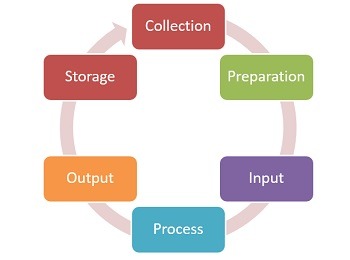
The concept of data processing involves the collection, manipulation, and transformation of raw data into meaningful information. It’s a fundamental aspect of information technology and is crucial for businesses, research, and various other fields. The data processing cycle typically includes several stages:
- Data Collection:
- The process begins with the collection of raw data. Data can be collected from various sources, such as forms, sensors, surveys, transactions, or other data-generating activities.
- Data Entry:
- Raw data needs to be entered into a computer system or another electronic device for processing. This can be done manually or automatically, depending on the source of the data.
- Data Cleaning:
- Raw data may contain errors, inconsistencies, or inaccuracies. Data cleaning involves identifying and correcting these issues to ensure the accuracy and reliability of the data.
- Data Storage:
- Processed data is stored in databases, data warehouses, or other storage systems. Proper data storage is essential for efficient retrieval and analysis.
- Data Processing:
- This is the core stage where raw data is transformed into a more meaningful format. Data processing can include various operations such as sorting, filtering, summarizing, and aggregating.
- Data Analysis:
- Processed data is analyzed to extract insights, identify patterns, and make informed decisions. Data analysis can involve statistical methods, machine learning algorithms, and other techniques depending on the goals.
- Data Visualization:
- Results from data analysis are often presented visually using charts, graphs, dashboards, or other visualization tools. Visualization makes complex data more accessible and aids in understanding trends and patterns.
- Information Output:
- The final stage involves presenting the processed and analyzed data in a format that is understandable and useful to end-users. This could be in the form of reports, summaries, or interactive dashboards.
- Feedback Loop:
- Depending on the results obtained, there might be a feedback loop that involves refining the data processing methods, adjusting data collection strategies, or updating analytical models to improve future processes.
Types of Data Processing:
- Batch Processing:
- Involves processing data in large volumes at scheduled intervals. Batch processing is suitable for non-time-sensitive tasks and can handle substantial amounts of data efficiently.
- Real-time Processing:
- Processes data as it is generated, providing immediate results. Real-time processing is crucial for applications where timely decision-making is essential, such as financial transactions or monitoring systems.
- Online Transaction Processing (OLTP):
- Focuses on transaction-oriented tasks, ensuring that databases are updated in real-time as transactions occur.
- Online Analytical Processing (OLAP):
- Focuses on complex queries and data analysis. OLAP systems allow users to interactively analyze multidimensional data.
Importance of Data Processing:
- Informed Decision-Making:
- Enables organizations to make data-driven decisions based on accurate and relevant information.
- Efficiency and Automation:
- Automates repetitive tasks, reducing manual effort and improving efficiency in handling large volumes of data.
- Improved Accuracy:
- Reduces errors and ensures data accuracy through data cleaning and validation processes.
- Knowledge Discovery:
- Unveils patterns, trends, and insights within data that might not be apparent in its raw form.
- Strategic Planning:
- Facilitates strategic planning by providing insights into market trends, customer behavior, and operational performance.
In summary, data processing is a fundamental concept that transforms raw data into actionable information, providing the foundation for decision-making and strategic planning in various domains.
What is required Concept of Data Processing
The concept of data processing encompasses several key elements and requirements that are fundamental to the effective and meaningful transformation of raw data into valuable information. Here are some essential concepts and requirements associated with data processing:
- Accuracy:
- Concept: Data processing should ensure the accuracy of information. This involves cleaning and validating data to eliminate errors, inconsistencies, and inaccuracies.
- Requirement: Implement data quality checks, validation rules, and cleaning procedures to maintain accurate data throughout the processing cycle.
- Timeliness:
- Concept: The relevance of data diminishes over time. Timely processing ensures that data is up-to-date and useful for decision-making.
- Requirement: Employ real-time processing or establish regular batch processing schedules to maintain data currency.
- Relevance:
- Concept: Processed data should be relevant to the goals and objectives of the organization. Irrelevant data can lead to inefficient use of resources.
- Requirement: Clearly define the goals of data processing and ensure that collected and processed data aligns with these objectives.
- Consistency:
- Concept: Consistency in data processing involves uniformity in formatting, units of measurement, and definitions to avoid confusion.
- Requirement: Establish standardized data formats, units, and definitions. Implement data governance practices to maintain consistency.
- Security:
- Concept: Protecting data from unauthorized access, manipulation, or loss is crucial for maintaining the integrity and confidentiality of information.
- Requirement: Implement robust security measures, including encryption, access controls, and authentication protocols, to safeguard processed data.
- Efficiency:
- Concept: Efficient data processing ensures that computational resources are used optimally, leading to faster and cost-effective results.
- Requirement: Optimize algorithms, use efficient data structures, and consider parallel processing to enhance the speed and efficiency of data processing.
- Scalability:
- Concept: Data processing systems should be scalable to handle growing volumes of data without sacrificing performance.
- Requirement: Design systems that can scale horizontally or vertically to accommodate increased data loads.
- Interoperability:
- Concept: Interoperability involves the ability of data processing systems to work seamlessly with other systems and technologies.
- Requirement: Use standardized data formats and communication protocols to enable interoperability between different systems and tools.
- User-Friendly Output:
- Concept: The output of data processing should be presented in a format that is easily understandable and usable by end-users.
- Requirement: Implement data visualization techniques and user-friendly interfaces to convey processed information effectively.
- Compliance:
- Concept: Adherence to legal and regulatory requirements regarding data processing, privacy, and security.
- Requirement: Stay informed about data protection laws and industry regulations, and ensure that data processing practices comply with these standards.
These concepts and requirements collectively contribute to the successful implementation of data processing systems, ensuring that organizations can derive valuable insights and make informed decisions based on high-quality, well-processed data.
The concept of data processing is relevant and required across various domains and roles within an organization. Here are some key stakeholders who typically engage with and require an understanding of the concept of data processing:
- Data Scientists and Analysts:
- Role: Data scientists and analysts are responsible for extracting insights from data. They leverage data processing techniques to clean, transform, and analyze large datasets to derive meaningful conclusions.
- Requirement: A deep understanding of data processing concepts is essential for these professionals to ensure the accuracy and reliability of their analyses.
- Database Administrators:
- Role: Database administrators manage and maintain databases, which are central to data storage and retrieval. They are involved in designing efficient data structures and optimizing data processing workflows.
- Requirement: Database administrators need a solid understanding of data processing to design and implement effective database systems.
- IT Professionals:
- Role: IT professionals, including system administrators and network administrators, are responsible for maintaining the infrastructure that supports data processing activities.
- Requirement: A strong grasp of data processing concepts is necessary for IT professionals to ensure the smooth operation and security of data processing systems.
- Developers and Programmers:
- Role: Developers and programmers create applications and software solutions that involve data processing. They write algorithms, design data structures, and implement processing logic.
- Requirement: Knowledge of data processing concepts is crucial for creating efficient and effective software solutions.
- Business Analysts:
- Role: Business analysts use data to make informed decisions that drive business strategies. They rely on data processing to transform raw data into actionable insights.
- Requirement: Business analysts need to understand data processing concepts to interpret and communicate data-driven insights effectively.
- Data Engineers:
- Role: Data engineers focus on the development and management of data architecture, including the processing pipelines that move and transform data from source to destination.
- Requirement: Data engineers require a deep understanding of data processing to design and implement robust data pipelines.
- Managers and Executives:
- Role: Managers and executives make strategic decisions based on data-driven insights. They rely on accurate and timely data processing to inform their decision-making processes.
- Requirement: While they may not be directly involved in the technical aspects, managers and executives benefit from a high-level understanding of data processing concepts.
- Compliance and Legal Professionals:
- Role: Professionals responsible for ensuring that data processing activities comply with legal and regulatory requirements.
- Requirement: Understanding data processing concepts is crucial for compliance professionals to ensure that data processing activities adhere to privacy laws and industry regulations.
- End Users:
- Role: End users interact with the output of data processing systems. This could include reports, dashboards, or other information derived from processed data.
- Requirement: While not involved in the technical implementation, end users benefit from an understanding of data processing concepts to interpret and use the information effectively.
In summary, the concept of data processing is relevant across a wide spectrum of roles within an organization, ranging from technical professionals directly involved in implementation to business leaders making strategic decisions based on data-driven insights. Each stakeholder group has its own specific requirements for understanding and applying data processing concepts within their respective domains.
The concept of data processing is required in various situations and contexts across different domains and industries. Here are common scenarios where an understanding of data processing is essential:
- Business Decision-Making:
- When Required: Business leaders and decision-makers need the concept of data processing to make informed decisions. This includes analyzing market trends, customer behavior, and financial data.
- Data Analysis and Reporting:
- When Required: Data analysts and scientists require data processing concepts to clean, transform, and analyze data. Reporting and visualization tools also rely on data processing principles to present information effectively.
- Software Development:
- When Required: Developers and programmers use data processing concepts to design algorithms, create efficient data structures, and implement logic for software applications that involve data manipulation.
- Database Management:
- When Required: Database administrators use data processing principles to manage databases effectively. This includes designing schemas, optimizing queries, and ensuring data integrity.
- Research and Academia:
- When Required: Researchers and academics utilize data processing techniques to analyze data in fields such as science, social sciences, and healthcare. It’s crucial for experimental design and data interpretation.
- IT Infrastructure Management:
- When Required: IT professionals managing networks and systems need data processing knowledge to ensure the efficient operation and security of data processing systems.
- Automation and Robotics:
- When Required: In industries involving automation and robotics, data processing concepts are used to analyze sensor data, make real-time decisions, and control automated systems.
- Financial Transactions:
- When Required: In the financial industry, data processing is critical for handling transactions, fraud detection, risk management, and maintaining accurate financial records.
- Healthcare and Medical Research:
- When Required: Healthcare professionals and researchers use data processing for patient records, medical imaging analysis, drug development, and epidemiological studies.
- Marketing and Customer Analytics:
- When Required: Marketing professionals leverage data processing to analyze customer behavior, target audiences effectively, and measure the success of marketing campaigns.
- E-commerce and Retail:
- When Required: In e-commerce, data processing is used for inventory management, personalized recommendations, and analyzing customer purchasing patterns.
- Government and Public Services:
- When Required: Government agencies use data processing for tasks such as census analysis, crime mapping, and resource allocation based on demographic data.
- Supply Chain Management:
- When Required: In logistics and supply chain management, data processing is essential for tracking inventory, optimizing routes, and ensuring efficient operations.
- Cybersecurity:
- When Required: Cybersecurity professionals utilize data processing techniques to monitor network traffic, detect anomalies, and respond to security incidents effectively.
- Education and Learning Analytics:
- When Required: Educational institutions use data processing for learning analytics, tracking student performance, and personalizing educational experiences.
In essence, the concept of data processing is required in any situation where data needs to be collected, analyzed, and transformed into meaningful information to support decision-making, operations, and various applications across different sectors.
The concept of data processing is required in a multitude of scenarios and industries where information needs to be collected, organized, analyzed, and utilized. Here are specific areas where the concept of data processing is crucial:
- Business and Finance:
- Where Required: Financial institutions use data processing for transaction processing, risk management, fraud detection, and financial analysis.
- Healthcare:
- Where Required: In healthcare, data processing is essential for patient record management, medical research, diagnosis, and treatment planning.
- Retail and E-commerce:
- Where Required: Retailers use data processing for inventory management, customer relationship management (CRM), and analyzing sales data to optimize pricing and promotions.
- Manufacturing and Supply Chain:
- Where Required: Manufacturers utilize data processing for supply chain management, production planning, quality control, and maintenance scheduling.
- Education:
- Where Required: Educational institutions employ data processing for student information systems, learning analytics, and administrative functions.
- Telecommunications:
- Where Required: Telecommunication companies use data processing for network management, billing systems, and customer service.
- Government and Public Services:
- Where Required: Government agencies rely on data processing for census data analysis, public safety, urban planning, and resource allocation.
- Energy and Utilities:
- Where Required: The energy sector utilizes data processing for grid management, demand forecasting, and monitoring equipment performance.
- Transportation and Logistics:
- Where Required: Companies in transportation and logistics use data processing for route optimization, shipment tracking, and inventory management.
- Marketing and Advertising:
- Where Required: Marketing agencies leverage data processing for customer segmentation, campaign analysis, and targeted advertising.
- Entertainment and Media:
- Where Required: Media and entertainment industries use data processing for content recommendation, audience analysis, and advertising placement.
- Human Resources:
- Where Required: HR departments utilize data processing for personnel management, payroll processing, and workforce analytics.
- Environmental Monitoring:
- Where Required: Environmental organizations use data processing for analyzing climate data, monitoring pollution levels, and managing conservation efforts.
- Agriculture:
- Where Required: Farmers and agricultural businesses use data processing for precision farming, crop monitoring, and yield optimization.
- Cybersecurity:
- Where Required: In the realm of cybersecurity, data processing is critical for analyzing network traffic, detecting anomalies, and responding to security threats.
- Smart Cities:
- Where Required: Cities implementing smart technologies use data processing for traffic management, waste optimization, and public service improvement.
- Social Sciences and Research:
- Where Required: Researchers across various disciplines use data processing for survey analysis, experimentation, and drawing insights from large datasets.
In essence, the concept of data processing is required wherever there is a need to transform raw data into meaningful information for decision-making, automation, optimization, and various applications across diverse industries and sectors.
The concept of data processing is required in numerous ways across various industries and applications. Here’s how the concept of data processing is crucial in different scenarios:
- Business Decision-Making:
- How Required: Data processing enables organizations to analyze historical and real-time data, providing valuable insights for strategic decision-making. It helps businesses understand market trends, customer behavior, and operational efficiency.
- Customer Relationship Management (CRM):
- How Required: In CRM systems, data processing is essential for managing customer interactions and relationships. It helps in tracking customer preferences, improving customer satisfaction, and personalizing marketing strategies.
- Financial Transactions:
- How Required: Banks and financial institutions rely on data processing for managing transactions, fraud detection, and risk assessment. It ensures the accuracy and security of financial data.
- Healthcare Management:
- How Required: Data processing is critical in healthcare for managing patient records, analyzing medical images, and supporting clinical decision-making. It enhances the efficiency of healthcare delivery and contributes to medical research.
- E-commerce and Retail:
- How Required: In e-commerce, data processing supports inventory management, order processing, and customer analytics. It helps retailers optimize pricing, promotions, and product recommendations.
- Supply Chain Optimization:
- How Required: Data processing is vital for optimizing supply chain operations. It facilitates real-time tracking of inventory, demand forecasting, and efficient logistics management.
- Educational Systems:
- How Required: Educational institutions use data processing for student enrollment, grading systems, and learning analytics. It aids in monitoring student performance and improving educational outcomes.
- Telecommunications:
- How Required: Telecommunication companies utilize data processing for network management, billing systems, and analyzing customer usage patterns. It supports the provision of reliable and efficient communication services.
- Manufacturing Processes:
- How Required: In manufacturing, data processing ensures efficient production planning, quality control, and maintenance scheduling. It contributes to optimizing overall operational processes.
- Human Resources Management:
- How Required: HR departments leverage data processing for payroll management, employee records, and workforce analytics. It aids in talent acquisition, performance evaluation, and resource planning.
- Energy and Utilities:
- How Required: The energy sector relies on data processing for monitoring power grids, predicting energy demand, and optimizing energy distribution. It contributes to resource efficiency and sustainability.
- Marketing and Advertising:
- How Required: Marketing agencies use data processing to analyze customer behavior, measure the effectiveness of advertising campaigns, and tailor marketing strategies to specific target audiences.
- Cybersecurity:
- How Required: In cybersecurity, data processing is crucial for monitoring network activities, detecting anomalies, and responding to security threats. It enhances the overall security posture of systems and networks.
- Smart Cities and Urban Planning:
- How Required: Data processing plays a key role in smart city initiatives, supporting urban planning, traffic management, waste optimization, and public service enhancement. It contributes to creating more sustainable and livable cities.
- Agriculture and Precision Farming:
- How Required: In agriculture, data processing supports precision farming, helping farmers optimize crop yields, monitor soil conditions, and manage resources efficiently.
- Research and Development:
- How Required: Researchers across various fields rely on data processing for analyzing experimental data, conducting simulations, and drawing meaningful conclusions. It accelerates the pace of scientific discovery.
In summary, the concept of data processing is required across diverse industries and applications, contributing to improved efficiency, informed decision-making, and innovation in various sectors of the economy.
Case Study on Concept of Data Processing
Certainly! Let’s consider a hypothetical case study to illustrate the concept of data processing in a real-world scenario:
Case Study: Optimizing Supply Chain Operations with Data Processing
Background:
XYZ Logistics, a global supply chain management company, handles the transportation and distribution of goods for various clients. As the volume of shipments increased, XYZ Logistics faced challenges in optimizing their supply chain operations efficiently. They decided to leverage data processing to enhance their decision-making processes, reduce operational costs, and improve overall customer satisfaction.
Challenges:
- Inefficient Inventory Management:
- The existing system struggled to provide real-time insights into inventory levels, leading to occasional stockouts and overstock situations.
- Suboptimal Route Planning:
- The route planning algorithm was not dynamic, resulting in inefficient transportation routes and increased fuel costs.
- Limited Visibility:
- Lack of real-time visibility into shipment status and warehouse activities made it challenging to address issues promptly and provide accurate delivery estimates to customers.
Implementation of Data Processing Solutions:
- Data Collection:
- XYZ Logistics implemented IoT devices and sensors to collect real-time data on inventory levels, vehicle locations, and warehouse activities. Data was collected at various points in the supply chain.
- Data Integration:
- Collected data from different sources, including warehouse management systems, GPS trackers, and inventory databases, was integrated into a centralized data repository for comprehensive analysis.
- Data Cleaning and Validation:
- A data cleaning process was initiated to identify and rectify inconsistencies and errors in the collected data, ensuring accuracy in subsequent analyses.
- Real-Time Analytics:
- Utilizing real-time analytics tools, XYZ Logistics processed data on current inventory levels, transportation routes, and shipment statuses. This allowed for dynamic decision-making based on the most up-to-date information.
- Predictive Analytics:
- Implementing predictive analytics models, XYZ Logistics forecasted demand, identified potential disruptions, and optimized inventory levels to prevent stockouts or excess inventory.
- Dynamic Route Optimization:
- The route planning algorithm was enhanced with dynamic features, taking into account real-time traffic data, weather conditions, and delivery priorities. This reduced transportation costs and improved delivery timelines.
- Customer Visibility Portal:
- A customer portal was developed to provide real-time visibility into shipment status and estimated delivery times. Customers could track their orders and receive timely updates.
- Automated Alerts and Notifications:
- Automated alerts were set up to notify stakeholders of critical events such as delays, inventory shortages, or route changes. This enabled proactive problem-solving and enhanced communication.
Results and Benefits:
- Operational Efficiency:
- The implementation of data processing solutions significantly improved operational efficiency. XYZ Logistics could adapt to changing conditions in real-time, reducing delays and bottlenecks.
- Cost Reduction:
- Dynamic route optimization and predictive analytics led to a substantial reduction in transportation costs, fuel consumption, and inventory holding costs.
- Improved Customer Satisfaction:
- The customer visibility portal and automated notifications improved transparency and communication with clients, leading to increased customer satisfaction.
- Data-Driven Decision-Making:
- Data processing empowered XYZ Logistics with actionable insights, enabling data-driven decision-making at every stage of the supply chain.
- Adaptability to Market Changes:
- With real-time analytics and predictive capabilities, XYZ Logistics could quickly adapt to market changes, making strategic decisions to stay ahead of competitors.
Conclusion:
In this case study, the implementation of data processing solutions transformed XYZ Logistics’ supply chain operations. By leveraging real-time and predictive analytics, they achieved greater operational efficiency, reduced costs, and enhanced customer satisfaction. The success of this initiative underscored the importance of the concept of data processing in optimizing complex business processes.
Certainly! Below is an outline for a white paper on the concept of data processing:
White Paper on the Concept of Data Processing
Abstract:
This white paper provides an in-depth exploration of the concept of data processing, elucidating its fundamental principles, applications across various industries, and its pivotal role in shaping modern business operations. It offers insights into the significance of data processing in a data-driven era and explores emerging trends and technologies in the field.
Table of Contents:
- Introduction
- Definition of Data Processing
- Evolution of Data Processing Technologies
- Key Principles of Data Processing
- Accuracy and Data Quality
- Timeliness
- Relevance
- Consistency
- Security
- Efficiency
- Scalability
- Interoperability
- Types of Data Processing
- Batch Processing
- Real-time Processing
- Online Transaction Processing (OLTP)
- Online Analytical Processing (OLAP)
- Data Processing in Action: Industry Applications
- Business and Finance
- Healthcare
- E-commerce and Retail
- Manufacturing and Supply Chain
- Telecommunications
- Education
- Government and Public Services
- Energy and Utilities
- Marketing and Advertising
- Cybersecurity
- Challenges and Considerations in Data Processing
- Big Data Challenges
- Privacy and Security Concerns
- Regulatory Compliance
- Ethical Considerations
- Advanced Data Processing Techniques
- Machine Learning and Predictive Analytics
- Artificial Intelligence in Data Processing
- Edge Computing
- Blockchain Technology
- The Role of Data Processing in Digital Transformation
- Data-Driven Decision-Making
- Automation and Efficiency Gains
- Customer Experience Enhancement
- Case Studies: Real-World Applications
- Optimizing Supply Chain Operations
- Healthcare Data Processing for Patient Care
- Financial Transactions and Fraud Detection
- Future Trends and Innovations
- Edge Computing and Edge Analytics
- Quantum Computing
- Explainable AI in Data Processing
- Continued Integration of IoT
- Conclusion
- Summary of Key Points
- The Future Landscape of Data Processing
Conclusion:
This white paper serves as a comprehensive guide to understanding the concept of data processing, from its foundational principles to its diverse applications across industries. As organizations continue to navigate the data-driven landscape, a deep understanding of data processing concepts becomes essential for informed decision-making, operational efficiency, and staying at the forefront of technological advancements.