
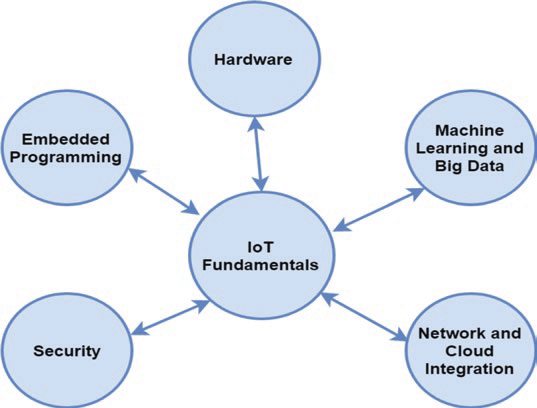
Fundamentals of IOT
The Internet of Things (Io T) refers to the network of physical objects, devices, and machines that are connected to the internet and are able to exchange data with each other. Io T is transforming the way we live and work by enabling smarter, more efficient, and more connected systems.
At its core, Io T is made up of three fundamental components:
- Devices and sensors: Io T devices and sensors are physical objects that are equipped with sensors, processors, and connectivity technologies, such as W i-F i or Bluetooth, that allow them to collect and transmit data. These devices can range from simple sensors that detect temperature or humidity to more complex devices, such as smart thermostats, security cameras, and wearable fitness trackers.
- Connectivity: Io T devices rely on connectivity technologies, such as Wi-Fi, cellular networks, or low-power wide-area networks (L PWAN), to communicate with other devices and systems. These networks enable the devices to exchange data with each other and with cloud-based servers and services.
- Data analytics: Io T generates vast amounts of data that need to be processed and analyzed to derive insights and make informed decisions. Data analytics tools and technologies, such as machine learning algorithms and predictive analytics, help organizations make sense of the data and identify patterns and trends.
By combining these three components, Io T can enable a wide range of applications and use cases, from smart homes and cities to industrial automation and healthcare. Some of the benefits of Io T include improved efficiency, enhanced safety and security, reduced costs, and better decision-making. However, Io T also presents some challenges, such as privacy and security concerns, interoperability issues, and data management complexity.