
Network topology
In computer networking, network topology refers to the physical or logical layout of interconnected devices and nodes in a computer network. There are several types of network topolog ies, including:
- Bus Topology: In this topology, all devices are connected to a single cable, which is called a bus. The devices communicate with each other by sending data packets over the bus.
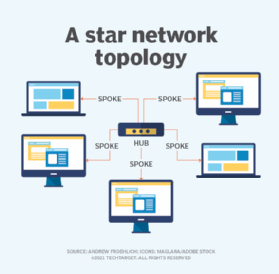
- Star Topology: In this topology, all devices are connected to a central device, such as a hub or switch. The central device manages the flow of data between the devices.
- Ring Topology: In this topology, all devices are connected in a circular loop. Data packets flow in one direction around the loop, with each device receiving and forwarding the packets.
- Mesh Topology: In this topology, every device is connected to every other device in the network. This type of topology provides redundancy and fault tolerance, as there are multiple paths for data to flow.
- Tree Topology: In this topology, devices are arranged in a hierarchical structure, with parent nodes and child nodes. Data packets flow from parent nodes to child nodes.
The choice of network topology depends on the requirements of the network, such as the number of devices, the amount of data being transmitted, and the level of fault tolerance required.