
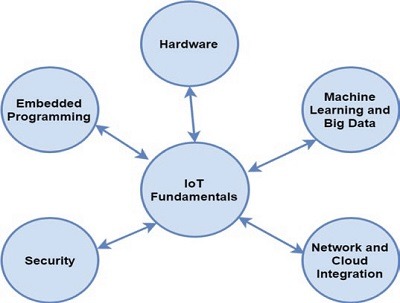
Fundamentals of IOT
The Internet of Things (IoT) refers to the network of interconnected devices, objects, and systems that communicate and exchange data over the internet. This enables them to collect, share, and analyze information, leading to automation, improved efficiency, and enhanced decision-making. Here are the fundamentals of IoT:
**1. Connectivity: IoT is built on the foundation of connectivity. Devices, sensors, and objects are equipped with communication technologies such as Wi-Fi, Bluetooth, cellular, Zigbee, and more. These technologies enable seamless data exchange between devices and the cloud.
**2. Sensors and Actuators: Sensors are the eyes and ears of IoT. They gather data from the physical environment, measuring parameters like temperature, humidity, light, motion, and more. Actuators, on the other hand, enable devices to take action based on the data received. For example, actuators can control motors, switches, valves, and other physical components.
**3. Data Processing and Analysis: IoT devices generate massive amounts of data. Cloud computing and edge computing play a crucial role in processing and analyzing this data. Cloud services provide the computational power and storage necessary for large-scale data processing, while edge computing allows data analysis to occur closer to the source, reducing latency and enhancing real-time capabilities.
**4. Connectivity Protocols: Various communication protocols are used to ensure seamless data exchange between IoT devices. These protocols include MQTT, CoAP, HTTP, AMQP, and more. The choice of protocol depends on factors like data volume, power efficiency, and reliability.
**5. Security and Privacy: Security is a critical consideration in IoT, as interconnected devices are vulnerable to cyber threats. Ensuring data encryption, secure authentication, and regular software updates is essential to safeguard devices and user privacy.
**6. Interoperability: Interoperability refers to the ability of different IoT devices and systems to communicate and work together seamlessly. Standardized protocols and frameworks promote interoperability, enabling devices from different manufacturers to collaborate effectively.
**7. Big Data and Analytics: IoT generates a vast amount of data, often referred to as “big data.” Analyzing this data helps extract valuable insights, patterns, and trends. Machine learning and AI techniques are employed to process and make sense of this data for informed decision-making.
**8. Use Cases of IoT: IoT has applications across various industries:
- Smart Homes: Smart thermostats, lights, security cameras, and appliances.
- Healthcare: Remote patient monitoring, wearable health devices.
- Industrial IoT (IIoT): Predictive maintenance, asset tracking, and process optimization.
- Smart Cities: Intelligent traffic management, waste management, and energy efficiency.
- Agriculture: Precision farming, monitoring crop conditions, and livestock tracking.
**9. Challenges of IoT: IoT faces challenges like security vulnerabilities, data privacy concerns, interoperability issues, and the need for efficient power management for battery-operated devices.
**10. Future of IoT: The IoT ecosystem is continually expanding, with advancements in 5G connectivity, edge computing, AI, and blockchain further enhancing its capabilities and potential use cases.
IoT is transforming industries, making everyday objects smarter and more connected, and opening up new possibilities for innovation and automation. As the technology continues to evolve, understanding its fundamentals is essential for harnessing its benefits effectively.
What is required Fundamental of IOT
To understand the fundamentals of the Internet of Things (IoT), you need to grasp several key concepts and principles. Here’s what is required to have a foundational understanding of IoT:
**1. Concept of Connectivity: Understand that IoT is all about connecting various devices, sensors, and objects to the internet and each other to enable data exchange and communication.
**2. Components of IoT Ecosystem: Learn about the main components of an IoT ecosystem, including devices, sensors, actuators, communication protocols, cloud computing, and data analytics.
**3. Sensor Technology: Gain insight into the types of sensors used in IoT, such as temperature sensors, humidity sensors, motion sensors, light sensors, and more. Understand how sensors collect data from the physical environment.
**4. Data Processing and Analytics: Learn about data processing techniques, including cloud computing and edge computing. Understand how data collected from IoT devices is processed and analyzed to extract valuable insights.
**5. Communication Protocols: Familiarize yourself with common communication protocols used in IoT, such as MQTT, CoAP, HTTP, and AMQP. Understand their roles in ensuring effective data transmission between devices and the cloud.
**6. Security and Privacy: Recognize the importance of security in IoT. Understand concepts like data encryption, secure authentication, and the risks associated with insecure IoT devices.
**7. Interoperability: Grasp the concept of interoperability, which enables different IoT devices and systems to communicate and work together. Learn how standard protocols and frameworks promote interoperability.
**8. Use Cases and Applications: Explore various use cases of IoT in industries like healthcare, smart homes, industrial automation, agriculture, transportation, and smart cities. Understand how IoT solutions enhance efficiency and convenience.
**9. Challenges and Considerations: Learn about the challenges facing IoT, including security vulnerabilities, data privacy concerns, interoperability issues, and the need for power-efficient designs for battery-operated devices.
**10. Future Trends and Advancements: Stay informed about emerging trends in IoT, such as 5G connectivity, edge computing, artificial intelligence (AI), and blockchain. Understand how these technologies contribute to IoT’s evolution.
**11. Real-World Examples: Study real-world examples of IoT implementations to see how the concepts you’ve learned are applied in practical scenarios.
**12. Continuous Learning: Recognize that IoT is a rapidly evolving field. Stay updated with new technologies, trends, and best practices through online resources, courses, forums, and industry events.
By understanding these fundamental concepts, you’ll be well-equipped to explore more advanced topics in IoT and even apply your knowledge to develop IoT solutions and projects.
Who is required Fundamentals of IOT
The understanding of the fundamentals of the Internet of Things (IoT) is relevant to a wide range of individuals across various roles and industries. Here are the groups of people who can benefit from having a grasp of the fundamentals of IoT:
- Technology Enthusiasts: Individuals who are passionate about technology and interested in staying updated with the latest advancements can benefit from understanding IoT fundamentals. This knowledge can enable them to explore new possibilities and innovations within the IoT space.
- Students and Educators: Students studying computer science, engineering, electronics, and related fields can gain insights into IoT concepts as part of their education. Educators can also teach IoT fundamentals to prepare students for the technology-driven world.
- IT Professionals: IT professionals, including network administrators, system engineers, and software developers, can enhance their skill set by understanding IoT principles. This knowledge is valuable as IoT devices become more integrated with business environments.
- Developers and Programmers: Developers interested in creating applications, software, and solutions that involve IoT components need a solid understanding of IoT fundamentals. This knowledge enables them to design and implement effective IoT systems.
- Engineers and Designers: Engineers, especially those working in fields like electronics, electrical engineering, and industrial design, can benefit from understanding how IoT devices and sensors work. This knowledge can help them create innovative products.
- Business Professionals: Business leaders, managers, and strategists need a foundational understanding of IoT to make informed decisions about adopting IoT solutions for their organizations. This understanding can aid in identifying new business opportunities and efficiencies.
- Entrepreneurs and Startups: Entrepreneurs looking to create IoT-based startups or develop IoT products can benefit from knowing the fundamentals. It helps them make informed decisions about technology, partnerships, and market positioning.
- Researchers and Innovators: Researchers interested in exploring new technologies and pushing the boundaries of IoT can use the fundamentals as a starting point for their work. Innovators can leverage IoT concepts to develop novel applications and solutions.
- Consumers and Users: Even for individuals who are not directly involved in technology fields, understanding IoT fundamentals can help them make informed decisions about using IoT devices in their daily lives. This includes understanding privacy and security considerations.
- Government and Policy Makers: Government officials and policymakers who deal with technology regulations and standards need a foundational understanding of IoT to create policies that ensure data privacy, security, and technological progress.
The fundamentals of IoT have broad applicability and relevance, as IoT continues to play a significant role in shaping various industries and aspects of modern life. Whether you’re a technology enthusiast, a professional in a related field, or simply curious about the technology, understanding IoT fundamentals can provide you with insights into this transformative domain.
When is required Fundamentals of IOT
Understanding the fundamentals of the Internet of Things (IoT) is required in various scenarios where individuals, professionals, or organizations aim to leverage or engage with IoT technologies. Here are some situations when a grasp of IoT fundamentals is necessary:
- Educational Settings:
- Students pursuing degrees or courses in computer science, engineering, electronics, or related fields need to understand IoT fundamentals as part of their curriculum.
- Professional Development:
- IT professionals, software developers, engineers, and other technology experts need to stay updated with IoT concepts to enhance their skill sets and remain competitive in the job market.
- Entrepreneurship and Innovation:
- Entrepreneurs and innovators interested in developing IoT-based products, services, or startups require a foundational understanding of IoT to conceptualize and execute their ideas effectively.
- Business Strategy:
- Business leaders and managers need to understand IoT to assess its potential impact on their industry, identify opportunities for operational improvements, and make informed strategic decisions.
- Technology Adoption:
- Organizations considering adopting IoT solutions for their operations, such as asset tracking, monitoring, or automation, need to understand the fundamentals to evaluate the feasibility and benefits of IoT implementation.
- Product Design and Development:
- Engineers, designers, and product developers working on creating IoT devices, wearables, smart appliances, and other connected products require a solid understanding of IoT principles.
- Policy and Regulation:
- Government officials, policymakers, and regulators dealing with technology standards and regulations need to understand IoT fundamentals to ensure privacy, security, and compliance in IoT deployments.
- Consumer Awareness:
- Individuals who use or interact with IoT devices, such as smart home appliances or wearables, should have a basic understanding of how these devices work, their features, and potential privacy implications.
- Research and Innovation:
- Researchers exploring novel applications of IoT, developing new technologies, or conducting studies related to IoT’s impact on society need a foundation in IoT fundamentals.
- Technology Enthusiasts:
- Individuals with a general interest in technology and the latest trends can benefit from understanding IoT fundamentals to keep themselves informed about technological advancements.
In essence, the need for understanding IoT fundamentals arises whenever IoT technologies have relevance to a person’s profession, interests, or decision-making processes. IoT’s broad impact across industries, business models, and daily life underscores the importance of having a foundational understanding of its principles.
Where is required Fundamentals of IOT
The understanding of the fundamentals of the Internet of Things (IoT) is required in various contexts and settings where IoT technologies are applicable. Here are some specific situations where a grasp of IoT fundamentals is necessary:
- Educational Institutions:
- Universities, colleges, and technical schools offer courses and programs focused on IoT. Students studying computer science, engineering, electronics, and related fields need to learn IoT fundamentals as part of their academic curriculum.
- Professional Training Workshops:
- Many organizations and training centers conduct workshops and seminars to educate professionals about IoT concepts. These workshops are relevant for IT professionals, engineers, and managers seeking to enhance their knowledge.
- Business and Industry:
- Industries such as manufacturing, healthcare, agriculture, and logistics are adopting IoT for operational efficiency. Employees and decision-makers in these sectors require a fundamental understanding of IoT to implement and manage IoT solutions.
- Tech Companies and Startups:
- Technology companies and startups that develop IoT devices, platforms, and services require employees with a solid understanding of IoT to design, develop, and support these products.
- Research Institutions:
- Researchers and scientists studying IoT-related topics need to understand its fundamentals to contribute to advancements in the field, explore new applications, and address challenges.
- Government and Policy Making:
- Government agencies responsible for technology regulations and standards need to comprehend IoT fundamentals to create policies that ensure data privacy, security, and responsible innovation.
- Consumer Education:
- Consumers purchasing and using IoT devices, such as smart home devices or wearables, should understand the basic principles of IoT to make informed decisions about their use and potential security considerations.
- IoT Development and Implementation Teams:
- Organizations planning to develop and deploy IoT solutions require teams with a collective understanding of IoT fundamentals to design, build, and manage successful IoT projects.
- Consulting and Advisory Services:
- Consultants and advisors in technology and business sectors need to be knowledgeable about IoT fundamentals to provide informed guidance to clients seeking to adopt IoT solutions.
- Technology Enthusiast Communities:
- Online forums, meetups, and conferences dedicated to technology and innovation often discuss IoT concepts. Individuals interested in tech trends benefit from understanding IoT fundamentals in such settings.
In essence, IoT fundamentals are required wherever IoT technologies are being used, developed, studied, or discussed. Given the increasing prevalence of IoT across various industries and aspects of life, having a foundational understanding of IoT is valuable for both personal and professional growth.
Who is required Fundamentals of IOT
The fundamentals of the Internet of Things (IoT) are required for a diverse range of individuals and professionals across various roles and industries. Here are some specific groups of people who benefit from understanding the fundamentals of IoT:
- Students:
- Those pursuing degrees in computer science, engineering, electronics, information technology, and related fields need a solid understanding of IoT fundamentals as part of their educational foundation.
- Engineers and Developers:
- Professionals involved in designing, developing, and programming IoT devices, systems, and applications require a deep understanding of IoT concepts to create effective and innovative solutions.
- IT Professionals:
- IT administrators, network engineers, and system architects need to understand IoT principles to manage IoT networks, ensure data security, and integrate IoT devices with existing infrastructure.
- Business Leaders and Managers:
- Business executives, managers, and decision-makers benefit from understanding IoT fundamentals to evaluate potential IoT solutions, make informed strategic decisions, and identify opportunities for digital transformation.
- Entrepreneurs and Innovators:
- Individuals aiming to start IoT-based businesses or develop innovative products require a foundational understanding of IoT to conceptualize, plan, and execute their ventures.
- Researchers and Academics:
- Researchers investigating IoT technologies, applications, and impacts need a solid grasp of IoT fundamentals to contribute to advancements in the field and publish meaningful research.
- Policy Makers and Regulators:
- Government officials and policymakers shaping technology regulations and standards must understand IoT fundamentals to create effective policies that ensure data privacy, security, and ethical use.
- Consumers and Users:
- Everyday users of IoT devices, including smart home appliances, wearables, and connected gadgets, can make better-informed decisions and navigate privacy concerns by understanding IoT basics.
- Consultants and Advisors:
- Technology consultants, advisors, and experts need to be well-versed in IoT fundamentals to provide accurate guidance and recommendations to clients seeking to adopt IoT solutions.
- Educators and Trainers:
- Educators teaching technology-related courses, workshops, or training programs require a strong grasp of IoT fundamentals to effectively convey the concepts to their students.
- Professionals in Relevant Industries:
- Professionals working in industries like healthcare, agriculture, manufacturing, logistics, energy, and transportation benefit from understanding IoT to leverage its applications in their specific domains.
In a rapidly evolving technological landscape, IoT is becoming increasingly integrated into various aspects of society and industries. Therefore, a foundational understanding of IoT is valuable for individuals across roles, industries, and interests.
Case study on Fundamentals of IOT
Certainly! Let’s explore a case study that highlights the importance of understanding the fundamentals of the Internet of Things (IoT):
Case Study: Smart Home Security Implementation
Background: Alice is a homeowner who is interested in enhancing the security of her residence using smart home devices. She wants to install a comprehensive IoT-based security system that includes smart cameras, motion sensors, door sensors, and remote monitoring capabilities.
Scenario: Alice is determined to implement the IoT-based smart home security system herself. She recognizes the importance of understanding the fundamentals of IoT to ensure the successful installation and operation of the system.
Importance of IoT Fundamentals: Understanding the fundamentals of IoT is crucial for Alice to effectively implement her smart home security system for the following reasons:
- Component Selection: Alice needs to choose compatible IoT devices, sensors, and controllers. Her understanding of IoT fundamentals helps her select devices that communicate seamlessly using common communication protocols.
- System Integration: To create a cohesive security system, Alice needs to integrate various devices to work together. Her knowledge of IoT principles enables her to configure devices to communicate, trigger actions, and provide alerts when security events occur.
- Data Management: Alice’s security system generates data from various sensors. Understanding IoT fundamentals helps her design a data management strategy, such as using edge computing to process data locally and sending critical alerts to the cloud.
- Security and Privacy: As Alice’s system deals with sensitive information, including footage from cameras, her understanding of IoT security fundamentals allows her to implement encryption, secure authentication, and regular software updates to prevent unauthorized access.
- Remote Monitoring: Alice wants to remotely monitor her home’s security status. With IoT fundamentals, she sets up a user-friendly interface that allows her to access real-time data and control her security system from her smartphone.
Steps Taken:
- Research: Alice researches various IoT devices, their features, and compatibility. She learns about IoT communication protocols and security best practices.
- Device Selection: Based on her research, Alice selects smart cameras, motion sensors, and door sensors that are compatible with each other and her smartphone.
- Configuration: Alice follows manufacturer guidelines and her understanding of IoT fundamentals to configure devices, connect them to her home network, and set up communication between sensors and the central control hub.
- Data Management: She configures the system to store critical data locally for immediate action and sends non-critical data to the cloud for analysis and storage.
- Security Implementation: Alice sets up secure login credentials, enables two-factor authentication, and updates device firmware regularly to keep her security system protected.
- Remote Monitoring: Using a dedicated app, Alice monitors her home’s security status remotely, receives alerts in case of unusual activity, and has the ability to control the system remotely.
Outcome: Thanks to her understanding of IoT fundamentals, Alice successfully implements a comprehensive smart home security system. Her system effectively detects and alerts her to security events, provides peace of mind, and enhances the overall security of her home.
Key Takeaway: This case study underscores how a solid understanding of IoT fundamentals empowers individuals like Alice to implement complex IoT-based systems effectively. It highlights the importance of knowledge in selecting, configuring, and securing IoT devices to create functional and secure solutions.
White paper on Fundamentals of IOT
Certainly! Here’s an example outline for a white paper on the fundamentals of the Internet of Things (IoT):
Title: White Paper on Fundamentals of the Internet of Things (IoT)
Abstract: This white paper provides a comprehensive overview of the fundamentals of the Internet of Things (IoT), exploring the concepts, components, and implications of this transformative technology. Whether you’re a student, professional, business leader, or technology enthusiast, this paper offers insights into the core principles that drive the IoT ecosystem.
Table of Contents:
- Introduction
- Definition of IoT and its significance in the modern digital age.
- Brief overview of IoT’s evolution and impact on various industries.
- Understanding IoT Concepts
- Defining the Internet of Things and its key concepts.
- Exploring the concept of interconnected devices and data exchange.
- Components of the IoT Ecosystem
- Overview of essential components: devices, sensors, actuators, connectivity technologies, and cloud infrastructure.
- Explanation of how these components work together to create IoT solutions.
- Data Collection and Communication
- Role of sensors in data collection from the physical world.
- Explanation of communication protocols used for seamless data exchange.
- Data Processing and Analytics
- Introduction to cloud computing and edge computing in IoT.
- How data processing and analytics contribute to deriving insights and actionable information.
- Security and Privacy Considerations
- Importance of security in IoT ecosystems.
- Discussion of encryption, authentication, and strategies to protect IoT devices and data.
- Interoperability and Standards
- The significance of standardized communication protocols for IoT devices.
- Role of interoperability in enabling devices from different manufacturers to work together.
- Use Cases and Applications
- Exploration of real-world applications in industries such as healthcare, agriculture, smart cities, industrial automation, and more.
- How IoT is driving innovation and efficiency in diverse sectors.
- Challenges and Future Trends
- Examination of challenges like security vulnerabilities, data privacy concerns, and scaling IoT networks.
- Discussion of future trends, including 5G connectivity, edge computing, and AI integration.
- Educational and Professional Opportunities
- How understanding IoT fundamentals benefits students, professionals, and businesses.
- Recommendations for further learning and resources to deepen IoT knowledge.
- Conclusion
- Recap of key takeaways from the paper.
- Emphasis on the ongoing evolution and importance of IoT in shaping the future.
References
- List of sources and references cited throughout the white paper.