
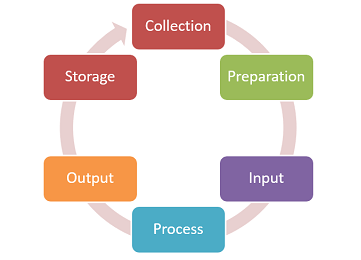
Concept of data processing
Data processing is the transformation of raw data into meaningful information through a series of operations and manipulations. It involves various techniques, tools, and methodologies to convert data into a usable format for analysis, decision-making, and other purposes. The concept of data processing encompasses several stages, including data collection, data entry, data cleaning, data transformation, data storage, data analysis, and data visualization.
Here’s a breakdown of each stage involved in data processing:
- Data collection: This involves gathering data from various sources, such as surveys, sensors, databases, websites, and other data repositories. The collected data can be structured (organized in a specific format like tables) or unstructured (not organized in a predefined format).
- Data entry: In this stage, collected data is manually entered into a computer system or automated processes are used to import data from external sources. Data entry ensures that the raw data is in a machine-readable format.
- Data cleaning: Raw data often contains errors, missing values, inconsistencies, or duplicates. Data cleaning involves removing or correcting these issues to enhance data quality. Techniques like filtering, validation, and data imputation are used to ensure accurate and reliable data.
- Data transformation: During this stage, data is transformed into a suitable format for further analysis. It may involve aggregating, summarizing, or restructuring the data. Data transformation prepares the data for processing based on specific requirements and goals.
- Data storage: Processed data needs to be stored in a structured manner to enable easy retrieval and future use. This can be done in databases, data warehouses, or data lakes, depending on the volume and nature of the data.
- Data analysis: Once the data is stored, it can be analyzed to extract meaningful insights and patterns. Data analysis involves applying statistical, mathematical, or computational techniques to identify trends, correlations, and relationships within the data. This stage often employs tools like data mining, machine learning, and statistical modeling.
- Data visualization: Data visualization presents the analyzed data in a visual format, such as charts, graphs, or dashboards. Visual representations make it easier to understand complex patterns, trends, and relationships within the data, enabling better decision-making and communication of insights.
The concept of data processing is fundamental to extracting knowledge and insights from data, enabling businesses, researchers, and organizations to make informed decisions and gain a deeper understanding of various phenomena.
What is required Concept of data processing
The concept of data processing requires several key elements and considerations. Here are some of the fundamental concepts related to data processing:
- Data quality: Data processing relies on high-quality data. It is essential to ensure that the data is accurate, complete, consistent, and relevant to the intended purpose. Data cleaning and validation techniques are employed to improve data quality.
- Data security and privacy: Data processing involves handling sensitive and confidential information. It is crucial to implement appropriate security measures to protect data from unauthorized access, loss, or alteration. Compliance with privacy regulations and ethical considerations is also essential to safeguard individuals’ personal information.
- Data integration: In many cases, data is collected from multiple sources and needs to be integrated to provide a comprehensive view. Data integration involves combining data from different systems or formats into a unified and consistent structure, enabling effective analysis and decision-making.
- Data processing techniques: Various techniques and tools are used for data processing, depending on the nature of the data and the desired outcomes. This may include data mining, statistical analysis, machine learning, natural language processing, or other computational methods.
- Scalability: With the ever-increasing volume of data, data processing systems need to be scal able to handle large datasets efficiently. Scalability ensures that data processing operations can be performed within a reasonable time frame and can accommodate future data growth.
- Real-time processing: In certain scenarios, data needs to be processed in real time to enable immediate actions or responses. Real-time data processing involves analyzing data as it is generated, often using streaming technologies, and making timely decisions or triggering automated processes.
- Data governance: Data governance refers to the overall management and control of data within an organization. It includes defining data standards, policies, and procedures to ensure data accuracy, security, and compliance. Data governance frameworks provide guidelines for data processing activities.
- Ethical considerations: Data processing raises ethical concerns regarding the use, sharing, and potential biases in data. It is important to handle data ethically, ensuring fairness, transparency, and accountability in data processing practices.
These concepts form the foundation for effective data processing, allowing organizations to derive valuable insights, make informed decisions, and gain a competitive advantage in various domains.
Who is required Concept of data processing
The concept of data processing is relevant to various individuals and roles within organizations. Here are some key stakeholders who are typically involved in data processing:
- Data Analysts: Data analysts are responsible for performing data processing tasks, including data cleaning, transformation, analysis, and visualization. They utilize statistical techniques, programming skills, and data processing tools to extract insights and make data-driven decisions.
- Data Scientists: Data scientists are involved in advanced data processing tasks, such as developing machine learning models, predictive analytics, and data mining techniques. They use sophisticated algorithms and statistical methods to extract patterns and trends from data.
- Data Engineers: Data engineers play a crucial role in designing and implementing the data processing infrastructure. They build data pipelines, data warehouses, and other systems to collect, store, and process large volumes of data efficiently.
- Database Administrators: Database administrators are responsible for managing and maintaining databases used in data processing. They ensure data integrity, security, and optimal performance of database systems.
- IT Professionals: IT professionals provide technical support for data processing systems. They handle the installation, configuration, and maintenance of hardware, software, and network infrastructure required for data processing.
- Business Analysts: Business analysts work closely with data analysts and data scientists to understand business requirements and translate them into data processing tasks. They provide domain knowledge and insights to guide the data processing and analysis process.
- Data Governance Officers: Data governance officers are responsible for establishing and enforcing data governance policies and procedures. They ensure that data processing practices adhere to legal, regulatory, and ethical standards, and manage data privacy and security.
- Decision-makers and Stakeholders: Decision-makers and stakeholders within organizations rely on data processing to make informed decisions. They use the insights generated from data processing to drive business strategies, improve operations, and address challenges.
It is important for these stakeholders to collaborate effectively, ensuring that data processing aligns with organizational goals, data quality requirements, and ethical considerations. Successful data processing often involves multidisciplinary teams working together to extract meaningful information and derive value from data.
When is required Concept of data processing
The concept of data processing is required in various scenarios and industries where data plays a crucial role in decision-making, analysis, and operations. Here are some common situations where data processing is essential:
- Business Intelligence: Data processing is necessary for organizations to gain insights into their operations, customer behavior, market trends, and financial performance. By processing and analyzing data, businesses can identify patterns, make informed decisions, and optimize their strategies.
- Scientific Research: Data processing is fundamental in scientific research fields such as physics, biology, chemistry, and social sciences. Researchers collect and process data to analyze experimental results, test hypotheses, and draw conclusions. Data processing enables them to uncover new discoveries, validate theories, and contribute to knowledge advancement.
- Healthcare and Medicine: Data processing plays a critical role in healthcare and medicine. It is used for patient record management, medical imaging analysis, clinical trials, drug discovery, disease surveillance, and personalized medicine. Processing healthcare data allows medical professionals to diagnose diseases, design treatment plans, and improve patient outcomes.
- Finance and Banking: Data processing is crucial in the finance and banking sector for tasks like risk analysis, fraud detection, customer segmentation, and investment strategies. Processing financial data enables institutions to assess market trends, identify anomalies, make accurate predictions, and mitigate risks.
- Marketing and Advertising: Data processing is essential for targeted marketing campaigns, customer segmentation, and advertising effectiveness analysis. By processing and analyzing consumer data, organizations can tailor their marketing efforts, optimize advertising spend, and deliver personalized experiences to customers.
- Manufacturing and Supply Chain: Data processing is utilized in optimizing production processes, monitoring supply chain operations, and improving efficiency. By processing data from sensors, machines, and production systems, manufacturers can identify bottlenecks, predict maintenance needs, and optimize resource allocation.
- Internet of Things (IoT): The Io T generates vast amounts of data from connected devices and sensors. Data processing is crucial for extracting meaningful information from this data, enabling real-time monitoring, predictive maintenance, and automated decision-making in various Io T applications such as smart cities, smart homes, and industrial automation.
- Customer Service and Support: Data processing is employed in customer service and support centers to analyze customer feedback, sentiment analysis, and customer behavior. Processing customer data helps organizations understand their customers’ needs, preferences, and pain points, enabling them to provide better services and support.
The concept of data processing is applicable in numerous industries and contexts where data-driven insights and decision-making are essential for achieving business objectives, improving processes, and delivering value to stakeholders.
Where is required Concept of data processing
The concept of data processing is required in various environments and settings where data is generated, collected, and utilized. Here are some specific areas where the concept of data processing is necessary:
- Enterprises and Organizations: Data processing is required in businesses and organizations of all sizes and across industries. It is used for tasks such as analyzing sales data, customer information, operational metrics, financial records, and supply chain data. Data processing enables organizations to optimize processes, make informed decisions, and gain a competitive edge.
- Research Institutions: Data processing is essential in research institutions, universities, and laboratories. Scientists and researchers rely on data processing to analyze experimental data, conduct statistical analysis, simulate models, and generate meaningful insights. It aids in advancing knowledge, validating hypotheses, and making scientific discoveries.
- Government Agencies: Government agencies utilize data processing for various purposes, including policy analysis, economic forecasting, demographic studies, and public service optimization. Data processing helps government bodies make informed decisions, allocate resources efficiently, and monitor and evaluate programs and initiatives.
- Healthcare Facilities: Data processing is critical in healthcare facilities, including hospitals, clinics, and research centers. Patient records, medical images, laboratory results, and genomic data are processed and analyzed to support diagnosis, treatment planning, research studies, and public health monitoring. Data processing enables healthcare professionals to provide quality care and improve patient outcomes.
- Financial Institutions: Banks, insurance companies, and financial institutions rely on data processing for tasks such as transaction processing, risk assessment, fraud detection, credit scoring, and investment analysis. Data processing helps these institutions make accurate financial decisions, manage risks, and provide personalized financial services.
- E-commerce and Retail: Data processing is crucial in e-commerce and retail industries. Customer behavior, sales transactions, inventory management, and supply chain data are processed to personalize marketing efforts, optimize pricing strategies, forecast demand, and enhance the customer shopping experience.
- Transportation and Logistics: Data processing plays a significant role in transportation and logistics sectors. It is used for route optimization, fleet management, tracking shipments, and supply chain visibility. Data processing helps improve efficiency, reduce costs, and ensure timely delivery of goods and services.
- Social Media and Digital Platforms: Social media platforms, online advertising networks, and digital platforms rely on data processing for user profiling, content recommendation, targeted advertising, and sentiment analysis. Data processing enables these platforms to provide personalized experiences, optimize user engagement, and deliver relevant content to users.
In essence, the concept of data processing is required in virtually every sector where data is generated and utilized. It empowers organizations and individuals to leverage data effectively, derive insights, and drive informed decision-making and actions.
How is required Concept of data processing
The concept of data processing is required to effectively handle and derive value from the ever-increasing volume, variety, and velocity of data generated in various domains. Here’s how the concept of data processing is necessary:
- Data Organization: Raw data is often unstructured or semi-structured, making it difficult to extract meaningful information. Data processing techniques, such as data cleaning and transformation, help organize and structure the data in a way that is suitable for analysis and decision-making.
- Data Integration: Organizations often need to combine data from multiple sources to gain a holistic view. Data processing enables the integration of disparate data sets, allowing for comprehensive analysis and insights. By merging and consolidating data, organizations can obtain a more accurate and comprehensive picture of the underlying phenomena.
- Data Analysis: Data processing techniques, including statistical analysis, machine learning, and data mining, are essential for extracting insights and patterns from the data. These techniques enable organizations to discover trends, correlations, and anomalies that would be otherwise challenging to identify. Data analysis helps in making data-driven decisions and discovering actionable insights.
- Real-time Decision-Making: In some contexts, real-time data processing is required for immediate decision-making or action. For example, in financial trading, fraud detection, or network monitoring, data needs to be processed and analyzed in real time to trigger timely responses. Real-time data processing enables organizations to react swiftly to changing conditions and make informed decisions in time-sensitive situations.
- Automation and Efficiency: Data processing allows for the automation of repetitive tasks, reducing manual effort and improving efficiency. Through automated data processing workflows, organizations can streamline data-related operations, such as data entry, data cleaning, and report generation. Automation reduces errors, enhances productivity, and accelerates the overall data processing workflow.
- Predictive Analytics: Data processing is instrumental in predictive analytics, where historical data is used to make future predictions. By analyzing historical patterns and trends, organizations can develop predictive models that forecast future outcomes. Predictive analytics enables proactive decision-making, risk assessment, and scenario planning.
- Data Visualization: Data processing is closely tied to data visualization, as it helps transform complex data into visual representations, such as charts, graphs, and dashboards. Visualizations facilitate easier understanding and interpretation of data, allowing decision-makers to grasp insights quickly and communicate them effectively.
- Regulatory Compliance: Many industries have regulations and compliance requirements regarding data processing, storage, and privacy. Adhering to these regulations is crucial to avoid legal issues and protect individuals’ rights. The concept of data processing includes ensuring data security, privacy, and compliance with applicable laws and regulations.
In summary, the concept of data processing is required to extract, organize, analyze, and visualize data effectively. It enables organizations to gain insights, make informed decisions, improve efficiency, and adhere to regulatory requirements, ultimately leading to enhanced performance and competitive advantage.
Case study on Concept of data processing
Case Study: Retail Analytics for Sales Optimization
Introduction: A retail company, ABC Retail, operates a chain of stores across multiple locations. They are interested in leveraging data processing techniques to optimize their sales strategies, improve customer engagement, and enhance overall business performance. By analyzing various data sources, they aim to identify customer preferences, optimize pricing, and enhance inventory management.
Data Collection and Integration: ABC Retail collects data from various sources, including point-of-sale (PO S) systems, customer loyalty programs, online sales platforms, and social media channels. The data includes transactional data, customer demographics, product information, and online customer interactions. The company integrates these data sources into a centralized data repository, ensuring data consistency and accuracy.
Data Cleaning and Transformation: To prepare the data for analysis, ABC Retail performs data cleaning and transformation. This involves removing duplicate records, correcting errors, filling in missing values, and standardizing data formats. They also categorize products, create customer segments based on demographics and buying behavior, and enrich the data with additional attributes, such as product categories and customer lifetime value.
Data Analysis and Insights: Using advanced data processing techniques, ABC Retail performs various analyses to derive insights and optimize their sales strategies. They apply machine learning algorithms to identify purchasing patterns, customer preferences, and cross-selling opportunities. By analyzing sales data, they uncover trends in product demand and seasonal variations. They also employ sentiment analysis on social media data to gauge customer satisfaction and identify potential areas for improvement.
Pricing Optimization: ABC Retail leverages data processing to optimize their pricing strategies. They analyze historical sales data, competitor pricing, and market trends to identify price elasticity and determine optimal price points for different products and customer segments. This helps them maximize sales revenue while remaining competitive in the market.
Inventory Management: Data processing enables ABC Retail to improve inventory management. By analyzing historical sales data and demand forecasts, they optimize inventory levels, identify slow-moving or excess inventory, and minimize stock outs. This helps them reduce carrying costs, improve product availability, and streamline their supply chain operations.
Personalized Marketing: Utilizing customer data and segmentation, ABC Retail tailors their marketing efforts to individual customer preferences. They employ data processing techniques to create personalized marketing campaigns, recommend products based on purchase history, and send targeted promotions to specific customer segments. This enhances customer engagement, increases customer loyalty, and drives sales growth.
Data Visualization and Reporting: To effectively communicate insights and monitor key performance indicators, ABC Retail utilizes data visualization techniques. They create interactive dashboards that provide real-time visibility into sales performance, customer metrics, and inventory levels. These visualizations enable decision-makers to monitor progress, identify areas of improvement, and make data-driven decisions.
Conclusion: By leveraging the concept of data processing, ABC Retail successfully optimizes their sales strategies, enhances customer engagement, and improves overall business performance. Through data collection, cleaning, transformation, and analysis, they gain valuable insights into customer behavior, pricing optimization, and inventory management. These insights enable them to make informed decisions, drive operational efficiency, and deliver an enhanced customer experience, ultimately leading to increased sales and profitability.
White paper on Concept of data processing
A white paper typically involves a detailed exploration of a specific topic or concept, backed by research, data, and industry insights.
However, I can provide you with an overview of the concept of data processing that can serve as a starting point for your white paper:
Title: Understanding the Concept of Data Processing: A Comprehensive Overview
Abstract: This white paper provides a comprehensive overview of the concept of data processing and its significance in today’s data-driven world. It explores the fundamental aspects, principles, and applications of data processing, along with its impact on organizations, industries, and society. The paper delves into the key components, techniques, and considerations involved in effective data processing. It also examines the role of data processing in driving decision-making, optimizing operations, and deriving valuable insights. Furthermore, the white paper discusses emerging trends and challenges in data processing and highlights ethical considerations related to data privacy, security, and governance. Through a thorough exploration of the concept, this white paper aims to provide readers with a deep understanding of data processing and its practical implications.
Table of Contents:
- Introduction
- Definition of Data Processing
- Importance of Data Processing in the Digital Age
- Key Components of Data Processing
- Data Collection and Integration
- Data Cleaning and Transformation
- Data Analysis and Modeling
- Data Visualization and Reporting
- Techniques and Tools for Data Processing
- Statistical Analysis
- Machine Learning and Predictive Modeling
- Natural Language Processing
- Big Data Technologies
- Applications of Data Processing
- Business Intelligence and Analytics
- Customer Relationship Management
- Healthcare and Medical Research
- Finance and Risk Management
- Manufacturing and Supply Chain Optimization
- Internet of Things (IoT) and Real-time Processing
- Data Processing Considerations
- Data Quality and Governance
- Data Security and Privacy
- Scalability and Performance
- Ethical Considerations and Bias in Data Processing
- Emerging Trends and Challenges in Data Processing
- Edge Computing and Decentralized Processing
- Privacy-Preserving Techniques
- Exploring Unstructured and Streaming Data
- Interoperability and Data Integration Challenges
- Conclusion
- Summary of Key Findings
- Implications and Future Directions of Data Processing
Please note that this outline provides a general structure for a white paper on the concept of data processing. You can further expand each section with relevant information, examples, case studies, and supporting research to create a comprehensive and insightful white paper on the topic.