
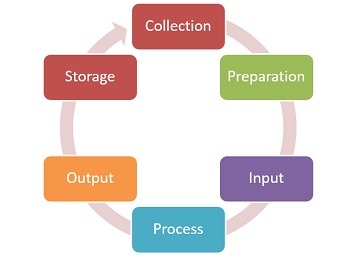
Concept of Data Processing
Data processing is a fundamental concept that encompasses the collection, manipulation, and transformation of data to produce meaningful information or achieve specific objectives. It plays a critical role in various fields, including computer science, business, science, and research. Here’s an overview of the concept of data processing:
- Data Input:
- Data processing begins with the collection or input of raw data. This data can be in various forms, such as text, numbers, images, or sensor readings.
- Data sources can include manual input, automated sensors, databases, or external data feeds.
- Data Storage:
- Once collected, data is typically stored in databases, data warehouses, or data repositories. Data storage ensures that the information is accessible for processing and analysis.
- Data Cleaning and Validation:
- Raw data often contains errors, inconsistencies, or missing values. Data processing involves cleaning and validating the data to ensure its accuracy and reliability.
- Data Transformation:
- Data may need to be transformed or converted into a more suitable format for analysis. This can include aggregating data, normalizing values, or changing data types.
- Data Analysis:
- Data processing enables data analysis, which involves using various techniques to extract insights, patterns, and trends from the data.
- Analysis can involve statistical methods, machine learning algorithms, data mining, and other tools.
- Data Visualization:
- To make data more understandable and insightful, it is often visualized through charts, graphs, dashboards, or reports.
- Visualization helps stakeholders interpret and make decisions based on the data.
- Data Storage and Retrieval:
- Processed data is often stored for future reference or retrieval. This can include archiving data for historical analysis or regulatory compliance.
- Data Output and Reporting:
- Processed data is used to generate reports, summaries, or actionable insights that are presented to stakeholders.
- Reports can inform decision-making, strategic planning, and performance evaluation.
- Automation and Integration:
- Many data processing tasks can be automated using software tools and scripts, allowing for efficient and timely processing of large datasets.
- Integration with other systems and applications is crucial to ensure data flows seamlessly across an organization.
- Security and Privacy:
- Data processing must consider security and privacy concerns. Protecting sensitive data and ensuring compliance with data protection regulations is essential.
- Real-time Data Processing:
- In some applications, data processing occurs in real-time, such as in financial trading systems, IoT applications, and network monitoring, where quick decisions are required.
- Big Data Processing:
- With the growth of big data, specialized tools and technologies, like Hadoop and Spark, are used for processing large volumes of data efficiently.
Data processing is a continuous and iterative process that adapts to the evolving needs and objectives of an organization. It underpins decision-making, research, automation, and the functioning of many modern systems and services. Effective data processing leads to improved efficiency, informed decision-making, and a competitive advantage in various industries.
What is required Concept of Data Processing
The required concept of data processing entails understanding the fundamental principles and key elements of how data is processed to produce meaningful information or achieve specific objectives. Here are the essential concepts related to data processing:
- Data Collection: Data processing begins with the collection of raw data from various sources, such as sensors, databases, forms, or external feeds. Data can come in structured (e.g., databases) or unstructured (e.g., text documents) formats.
- Data Input: Data must be accurately and efficiently input into a data processing system. This can involve manual entry, automated data capture, or data ingestion from various sources.
- Data Storage: The collected data is stored in databases, data warehouses, or other data repositories. Effective data storage ensures data accessibility and security.
- Data Cleaning and Validation: Raw data often contains errors, inconsistencies, and missing values. Data processing includes data cleaning and validation to ensure data accuracy and reliability.
- Data Transformation: Data may need to be transformed or prepared for analysis. This can involve tasks like data normalization, aggregation, or changing data types to facilitate meaningful analysis.
- Data Analysis: Data processing enables data analysis, where data is examined to extract insights, patterns, trends, and valuable information. Data analysis can use various techniques, including statistical methods and machine learning algorithms.
- Data Visualization: To make data more interpretable and insightful, it is often visualized using charts, graphs, dashboards, or reports. Data visualization aids in communicating findings to stakeholders.
- Data Storage and Retrieval: Processed data may be archived or stored for future reference or retrieval, especially for historical analysis, regulatory compliance, or further use.
- Data Output and Reporting: Processed data is used to generate reports, summaries, or actionable insights that inform decision-making, strategic planning, and performance evaluation.
- Automation and Integration: Automation of data processing tasks using software tools and scripts can ensure efficient and timely processing of large datasets. Integration with other systems and applications is essential for seamless data flow.
- Security and Privacy: Data processing must address security and privacy concerns. Safeguarding sensitive data and complying with data protection regulations is critical.
- Real-time Data Processing: In some applications, data processing occurs in real-time, where data is processed and acted upon immediately, such as in financial trading, IoT applications, or network monitoring.
- Big Data Processing: With the advent of big data, specialized tools and technologies like Hadoop and Spark are used to process large volumes of data efficiently.
- Feedback and Iteration: Data processing is often an iterative process where feedback from analysis results in adjustments to data processing workflows and data collection strategies.
- Data Lifecycle Management: Managing the entire data lifecycle, from data creation and collection to archival and deletion, is crucial for efficient data processing.
Understanding these required concepts is essential for effectively harnessing data to gain insights, make informed decisions, and improve efficiency in various domains, including business, science, and technology.
Who is required Concept of Data Processing
The concept of data processing is not attributed to a specific individual or entity. It is a fundamental concept in the field of computer science, information technology, and data management that has evolved over time as technology and data-related challenges have advanced. It represents a systematic approach to collecting, transforming, and analyzing data to derive meaningful insights and support decision-making processes.
The principles of data processing have been developed and refined collectively by experts and professionals in various fields, including computer scientists, data analysts, statisticians, and engineers. These principles have become an integral part of data-driven decision-making in modern society, impacting industries, research, and everyday life.
While there isn’t a single person associated with the concept of data processing, many individuals have made significant contributions to the development of data processing techniques, technologies, and methodologies over the years. This includes pioneers in computer science, like Alan Turing and John von Neumann, as well as contemporary data scientists and researchers who continue to advance the field.
In essence, the concept of data processing is a collective and evolving understanding of how data can be effectively managed, analyzed, and leveraged to extract valuable information and insights. It is foundational to modern computing and information systems.
When is required Concept of Data Processing
The concept of data processing is required in various contexts and situations where data needs to be collected, analyzed, and transformed to serve specific purposes. Here are some common scenarios when the concept of data processing is essential:
- Business Operations: Data processing is integral to business operations, including sales, inventory management, customer relationship management, and financial reporting. Companies use data processing to track transactions, manage resources, and make informed decisions.
- Scientific Research: Researchers use data processing to collect, analyze, and interpret data in various scientific disciplines, including physics, biology, and social sciences. Data processing enables hypothesis testing and the discovery of patterns and trends.
- Healthcare: In healthcare, data processing is crucial for managing patient records, diagnostic information, and medical research. Electronic health records (EHRs) and data analytics are common applications.
- Financial Services: Financial institutions use data processing for tasks like fraud detection, risk assessment, and algorithmic trading. This includes processing vast amounts of financial data in real-time.
- Manufacturing and Quality Control: Manufacturing companies use data processing to monitor and control production processes, ensuring quality and efficiency. Sensors and automation play a significant role in data-driven manufacturing.
- E-commerce and Retail: Online retailers employ data processing for personalization, inventory management, and supply chain optimization. Customer behavior data is processed to make product recommendations.
- Transportation and Logistics: The transportation industry relies on data processing for route optimization, fleet management, and real-time tracking of goods. GPS, sensors, and IoT devices are critical components.
- Energy and Utilities: The energy sector uses data processing for grid management, energy consumption analysis, and predictive maintenance of infrastructure.
- Agriculture: Precision agriculture leverages data processing to monitor crop health, optimize irrigation, and manage resources efficiently.
- Education: Educational institutions use data processing for student records, grading, and educational research to improve teaching methods and outcomes.
- Smart Cities: In the development of smart cities, data processing is used for traffic management, waste collection, energy efficiency, and public safety.
- Government and Public Policy: Governments employ data processing to inform public policy, conduct censuses, and analyze socioeconomic data.
- Environmental Monitoring: Environmental agencies use data processing to analyze climate data, track pollution levels, and predict natural disasters.
- Entertainment and Social Media: Social media platforms and entertainment companies process user data to personalize content, target ads, and analyze user behavior.
- Security and Surveillance: Law enforcement and security agencies use data processing for video surveillance, facial recognition, and threat detection.
- Research and Development: Companies and institutions rely on data processing for innovation, new product development, and technology advancement.
In summary, the concept of data processing is required in a wide range of industries and applications. It is fundamental to understanding, managing, and deriving insights from data to improve efficiency, decision-making, and the overall functioning of organizations and systems.
Where is required Concept of Data Processing
The concept of data processing is required in various locations or contexts where data is generated, collected, and used for specific purposes. Here are some common places or settings where the concept of data processing is essential:
- Businesses and Corporations: Data processing is crucial in the business world for activities such as sales and marketing, inventory management, customer relationship management, financial analysis, and decision-making. It is used in offices, factories, and other business environments.
- Healthcare Facilities: Hospitals, clinics, and healthcare organizations rely on data processing to manage patient records, diagnostic data, billing, and medical research. Electronic health records (EHRs) are processed in healthcare settings.
- Financial Institutions: Banks, investment firms, and insurance companies use data processing for financial transactions, fraud detection, risk assessment, and customer account management. Stock exchanges and trading firms process financial data in real-time.
- Educational Institutions: Schools, colleges, and universities employ data processing for student records, grading, course management, and educational research.
- Government Agencies: Government departments and agencies use data processing for various purposes, including census data collection, public policy analysis, and administrative tasks.
- Manufacturing and Industrial Facilities: Data processing is critical for monitoring and controlling production processes, quality assurance, and predictive maintenance in manufacturing and industrial settings.
- Agriculture: Farms and agricultural operations use data processing to monitor crop health, optimize irrigation, and manage resources efficiently.
- Energy and Utilities: Data processing is essential for energy and utility companies to manage energy grids, analyze consumption patterns, and predict maintenance needs.
- Transportation and Logistics: The transportation and logistics industry relies on data processing for route optimization, fleet management, and real-time tracking of goods and vehicles.
- Research Laboratories: Scientific and research institutions process data to analyze experimental results, conduct simulations, and advance knowledge in various fields.
- Smart Cities: Data processing is integral to smart city initiatives, helping with traffic management, waste collection, energy efficiency, and public safety.
- Environmental Monitoring: Environmental agencies process data to analyze climate conditions, track pollution levels, and predict natural disasters.
- Entertainment and Media: Data processing is used in entertainment and media for content personalization, ad targeting, audience analysis, and video streaming.
- Data Centers: Data centers are dedicated facilities that process and store vast amounts of data for various purposes, including cloud computing, web hosting, and IT services.
- Internet and Social Media Platforms: Social media companies and online platforms process user data for content delivery, ad targeting, and user behavior analysis.
- Security and Surveillance: Law enforcement agencies and security organizations process data for video surveillance, facial recognition, and threat detection.
- Research and Development Facilities: Companies and research institutions employ data processing for innovation, product development, and technology advancement.
The concept of data processing is integral to these settings and many others, as it plays a critical role in optimizing operations, decision-making, and data-driven outcomes across a wide range of industries and applications.
How is required Concept of Data Processing
The concept of data processing is required in various ways and is executed through a structured process to ensure that data is transformed into meaningful information or serves a specific purpose. Here is how the concept of data processing is typically executed:
- Data Collection:
- Data processing begins with the collection of raw data from various sources. This can include manual data entry, automated data capture systems, sensors, databases, or external data feeds.
- Data Input:
- Collected data is accurately and efficiently input into a data processing system. This can involve manual entry, automated data ingestion, or integration with data sources.
- Data Storage:
- Data is stored in databases, data warehouses, or other storage systems. Effective data storage ensures data accessibility, security, and availability.
- Data Cleaning and Validation:
- Raw data often contains errors, inconsistencies, or missing values. Data processing includes data cleaning and validation to ensure data accuracy and reliability.
- Data Transformation:
- Data may need to be transformed or prepared for analysis. This can involve tasks like data normalization, aggregation, or changing data types to facilitate meaningful analysis.
- Data Analysis:
- Data processing enables data analysis, where data is examined to extract insights, patterns, trends, and valuable information. Data analysis can use various techniques, including statistical methods and machine learning algorithms.
- Data Visualization:
- To make data more interpretable and insightful, it is often visualized using charts, graphs, dashboards, or reports. Data visualization aids in communicating findings to stakeholders.
- Data Storage and Retrieval:
- Processed data may be archived or stored for future reference or retrieval, especially for historical analysis, regulatory compliance, or further use.
- Data Output and Reporting:
- Processed data is used to generate reports, summaries, or actionable insights that inform decision-making, strategic planning, and performance evaluation.
- Automation and Integration:
- Automation of data processing tasks using software tools and scripts ensures efficient and timely processing of large datasets. Integration with other systems and applications is essential for seamless data flow.
- Security and Privacy:
- Data processing must address security and privacy concerns. Safeguarding sensitive data and complying with data protection regulations is critical.
- Real-time Data Processing:
- In some applications, data processing occurs in real-time, where data is processed and acted upon immediately, such as in financial trading, IoT applications, or network monitoring.
- Big Data Processing:
- With the advent of big data, specialized tools and technologies, like Hadoop and Spark, are used to process large volumes of data efficiently.
The execution of data processing is iterative, ongoing, and tailored to specific goals and requirements. It is a foundational concept in modern computing and information systems, enabling organizations to extract valuable insights from data and make informed decisions.
Case Study on Concept of Data Processing
Certainly! Let’s consider a case study on the concept of data processing in the context of a healthcare facility:
Case Study: Optimizing Data Processing in a Healthcare Clinic
Background: A healthcare clinic, “Healthy Care Clinic,” is a multi-specialty medical facility serving a diverse patient population. The clinic had been facing several challenges related to data processing, including appointment scheduling, patient records, and billing. These challenges were affecting patient care and overall efficiency.
Challenges:
- Appointment Scheduling: The clinic’s appointment scheduling system was manual, leading to scheduling conflicts, long patient wait times, and inefficiency in resource allocation.
- Patient Records: Patient records were paper-based, causing delays in accessing critical patient information, increasing the risk of errors, and slowing down healthcare providers.
- Billing and Insurance Claims: The billing process was error-prone, resulting in delayed payments and frequent disputes with insurance providers.
- Data Security: Patient data security was a concern, as paper records could be easily accessed by unauthorized individuals.
Solution:
Healthy Care Clinic implemented a comprehensive data processing solution to address these challenges:
- Electronic Health Records (EHR):
- Transitioned from paper records to EHR systems, allowing for real-time access to patient data by authorized healthcare providers.
- Appointment Scheduling System:
- Implemented an automated appointment scheduling system, reducing scheduling conflicts, improving patient flow, and optimizing resource allocation.
- Billing and Claims Management Software:
- Adopted billing and claims management software to streamline the billing process, reducing errors, and accelerating payments from insurance providers.
- Data Security Measures:
- Implemented robust data security measures to protect patient information, including encryption, user access controls, and compliance with healthcare data privacy regulations.
Results:
The implementation of the data processing solution led to several positive outcomes:
- Efficiency and Patient Care: With EHR and automated scheduling, the clinic improved patient care by reducing wait times, eliminating scheduling conflicts, and enhancing resource allocation.
- Billing Accuracy: The billing and claims management software reduced billing errors and disputes, leading to faster and more accurate payments from insurance providers.
- Data Security: Robust security measures safeguarded patient data, ensuring compliance with healthcare data privacy regulations and building trust among patients.
- Cost Reduction: Reduced paper-based processes resulted in cost savings associated with printing, storage, and manual record-keeping.
- Patient Satisfaction: Patients experienced shorter wait times, improved accuracy of medical records, and a more streamlined billing process, leading to higher overall satisfaction.
Conclusion:
The case study of Healthy Care Clinic demonstrates how the concept of data processing, including the transition from manual, paper-based systems to automated, digital processes, can significantly improve efficiency, patient care, and data security in a healthcare setting. Data processing solutions optimized the clinic’s operations and enhanced patient experience.
White Paper on Concept of Data Processing
Creating a white paper on the concept of data processing can provide an in-depth understanding of its importance, principles, and applications. Below is an outline for a white paper on this topic:
Title: Unveiling Data Processing: The Key to Informed Decision-Making
Table of Contents
- Executive Summary
- Introduction
- Definition of Data Processing
- The Significance of Data Processing
- The Evolution of Data Processing
- Key Principles of Data Processing
- Data Collection
- Data Validation and Cleaning
- Data Transformation
- Data Analysis
- Data Visualization
- Data Security and Privacy
- Data Processing Technologies
- Traditional Data Processing Methods
- Big Data and Analytics
- Real-time Data Processing
- Data Processing Tools and Software
- Applications of Data Processing
- Business and Finance
- Healthcare
- Manufacturing and Industry
- Education
- Research and Development
- Smart Cities and IoT
- Challenges and Solutions in Data Processing
- Data Quality and Integrity
- Scalability
- Data Privacy Concerns
- Compliance with Data Regulations
- Security Threats and Cybersecurity
- Case Studies
- Healthcare: Transition to Electronic Health Records
- Financial Services: Data Processing in Investment Banking
- Manufacturing: Optimizing Production with Data Processing
- Smart Cities: Enhancing Urban Living through Data Processing
- The Future of Data Processing
- Trends in Data Processing
- The Impact of Artificial Intelligence and Machine Learning
- Data Ethics and Responsible Data Processing
- Conclusion
- The Role of Data Processing in the Digital Age
- The Continuous Evolution of Data Processing
- References
This white paper would provide a comprehensive overview of the concept of data processing, its principles, technologies, applications, challenges, and future trends. It would also include real-world case studies to illustrate the practical significance of data processing in various industries.