
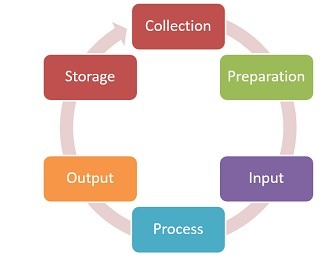
Concept of data processing
The concept of data processing refers to the manipulation and transformation of raw data into meaningful information through a series of organized and structured steps. It involves the collection, organization, analysis, and transformation of data to extract valuable insights, make informed decisions, and support various business processes. Data processing can be performed manually or with the assistance of computer systems and software.
Here are the key stages involved in the data processing cycle:
- Data Collection: The first step is to gather relevant data from various sources, such as databases, surveys, sensors, or external sources. Data can be collected in different formats, including structured data (e.g., databases, spreadsheets) or unstructured data (e.g., text documents, social media posts).
- Data Entry: Data is entered into a system or software, ensuring accuracy and completeness. This can involve manual data entry or automated processes for data ingestion.
- Data Validation and Cleaning: The collected data is checked for accuracy, consistency, and completeness. Any errors, inconsistencies, or missing values are identified and corrected through data cleaning processes. This step aims to ensure that the data is reliable and suitable for further processing.
- Data Transformation: In this stage, the collected data is transformed or formatted to meet the requirements of the desired analysis or application. This can involve tasks such as data normalization, aggregation, filtering, or merging different data sources.
- Data Storage: Processed data is stored in databases, data warehouses, or other storage systems. Proper data storage ensures data integrity, accessibility, and security.
- Data Analysis: The processed data is analyzed to discover patterns, relationships, and insights. Various statistical, mathematical, or machine learning techniques can be applied to uncover meaningful information and support decision-making.
- Data Visualization and Reporting: The results of the data analysis are often presented through visualizations, charts, graphs, or reports to effectively communicate the findings to stakeholders. Data visualization helps to understand complex data and identify trends or patterns easily.
- Data Interpretation and Decision Making: The analyzed information is interpreted and used to make informed decisions, drive actions, or improve processes. Data-driven insights support organizations in optimizing operations, identifying opportunities, and addressing challenges.
- Data Maintenance and Updates: Data processing is an ongoing process, and as new data is collected, it goes through the same cycle of processing steps. Regular maintenance, updates, and quality control ensure the accuracy, relevance, and timeliness of the processed data.
Data processing plays a vital role in various domains, including business intelligence, scientific research, finance, healthcare, and marketing. The availability of powerful computing technologies and advanced analytics tools has significantly accelerated the speed and efficiency of data processing, enabling organizations to leverage data as a strategic asset in today’s data-driven world.
What is required Concept of data processing
The concept of data processing requires several key elements to be effectively implemented. Here are the essential requirements for the concept of data processing:
- Data Collection Mechanisms: Reliable and efficient mechanisms are needed to collect data from various sources. This includes the use of data collection tools, sensors, APIs (Application Programming Interfaces), data entry systems, or automated data ingestion processes. The data collection mechanisms should ensure accurate and timely acquisition of data.
- Data Storage Infrastructure: Adequate storage infrastructure is required to securely store the collected data. This may involve databases, data warehouses, data lakes, or cloud storage systems. The storage infrastructure should have sufficient capacity, scalability, and data redundancy to accommodate the growing volume of data.
- Data Quality Assurance: Ensuring data quality is crucial for reliable data processing. Data quality assurance involves data validation, cleaning, and standardization processes to identify and correct errors, inconsistencies, or missing values. Data quality checks and validation rules are established to maintain the accuracy, completeness, and consistency of the data.
- Data Processing Tools and Software: Utilizing appropriate data processing tools and software is essential. This includes software applications, programming languages, data integration tools, ETL (Extract, Transform, Load) tools, data analytics platforms, and visualization tools. These tools enable efficient data manipulation, transformation, analysis, and visualization to derive valuable insights from the data.
- Data Security and Privacy Measures: Data processing requires strong security and privacy measures to protect sensitive and confidential information. This includes implementing access controls, encryption, data anonymization techniques, user authentication, and compliance with data protection regulations and policies. Protecting data from unauthorized access, breaches, or misuse is critical.
- Data Governance and Management: Effective data governance practices and management processes are necessary to ensure the availability, integrity, and reliability of the data. This includes defining data governance frameworks, establishing data management policies, assigning data ownership, and implementing data stewardship roles and responsibilities. Data governance ensures proper data usage, compliance, and adherence to organizational standards.
- Data Analysis and Interpretation: Data processing requires analytical capabilities to analyze, interpret, and derive meaningful insights from the processed data. This involves applying statistical, mathematical, or machine learning techniques to discover patterns, trends, correlations, or anomalies in the data. Data visualization techniques help in presenting the analysis results in a clear and understandable manner.
- Data Integration and Interoperability: Data processing often involves integrating data from multiple sources or systems. Ensuring interoperability and seamless integration between different data formats, databases, or applications is crucial. This enables a comprehensive view of the data and facilitates effective data processing and analysis.
- Data Lifecycle Management: Data processing requires a well-defined data lifecycle management approach. This includes data acquisition, storage, processing, archiving, and disposal stages. Managing data throughout its lifecycle ensures data relevance, availability, and compliance with data retention policies and legal requirements.
By fulfilling these requirements, organizations can effectively implement the concept of data processing and leverage data as a strategic asset to drive decision-making, gain insights, and achieve business objectives.
Who is required Concept of data processing ?
The concept of data processing requires involvement from various individuals and roles within an organization. Here are the key stakeholders who play a role in the concept of data processing:
- Data Analysts: Data analysts are responsible for processing and analyzing data to derive meaningful insights. They utilize data processing tools, statistical techniques, and programming languages to clean, transform, and analyze data. Data analysts are skilled in data manipulation, data visualization, and data interpretation to support decision-making processes.
- Data Scientists: Data scientists are involved in the advanced analysis of data, applying statistical models, machine learning algorithms, and predictive analytics techniques. They work on complex data processing tasks, feature engineering, and developing predictive models to extract valuable insights and patterns from the data.
- Data Engineers: Data engineers focus on the technical aspects of data processing. They design and develop data pipelines, data integration processes, and ETL (Extract, Transform, Load) workflows. Data engineers ensure efficient data ingestion, transformation, and integration from various sources into the data processing systems.
- Database Administrators: Database administrators (DBAs) are responsible for managing the storage and retrieval of data. They ensure the availability, integrity, and security of databases and data storage systems. DBAs optimize database performance, implement data backup and recovery strategies, and maintain data integrity during the data processing cycle.
- Data Stewards: Data stewards are individuals assigned with the responsibility of overseeing data governance and data management practices. They define data standards, policies, and procedures, ensuring compliance with regulatory requirements and industry best practices. Data stewards monitor data quality, enforce data access controls, and promote data governance across the organization.
- IT Professionals: IT professionals play a crucial role in supporting the technical infrastructure required for data processing. They manage the hardware, networks, servers, and software systems necessary for efficient data processing. IT professionals ensure the availability, security, and scalability of the data processing environment.
- Business Stakeholders: Business stakeholders, including managers, executives, and decision-makers, provide guidance and requirements for data processing. They define the objectives, key performance indicators (KPIs), and business questions to be answered through data processing and analysis. Business stakeholders work closely with data analysts and scientists to interpret the insights derived from data processing and make informed decisions.
- Data Privacy and Security Professionals: With the increasing emphasis on data privacy and security, professionals specializing in data privacy and security are essential in the concept of data processing. They ensure compliance with data protection regulations, assess and mitigate data security risks, and implement appropriate access controls and encryption measures to protect sensitive data.
- End Users: End users, such as business users, marketing professionals, or researchers, utilize the processed data and insights for their specific needs. They rely on accurate and timely data processing to support their day-to-day operations, decision-making, and strategic initiatives.
Collaboration and coordination among these stakeholders are crucial for successful implementation of the concept of data processing. Each role contributes to different aspects of data processing, ranging from technical implementation to data analysis and interpretation, ensuring that the processed data is valuable, accurate, and releva
t to the organization’s goals and objectives.
When is required Concept of data processing ?
The concept of data processing is required in various scenarios and contexts where organizations or individuals need to make sense of large amounts of data to extract valuable insights, support decision-making processes, or optimize business operations. Here are some common situations where the concept of data processing is necessary:
- Business Analytics and Intelligence: Organizations often utilize data processing to analyze historical and real-time data to gain insights into customer behavior, market trends, and business performance. Data processing enables businesses to identify patterns, correlations, and anomalies that can drive strategic decision-making, optimize marketing campaigns, improve operational efficiency, and enhance overall business performance.
- Scientific Research and Analysis: Data processing is crucial in scientific research fields, where large volumes of data are collected, processed, and analyzed to draw conclusions, test hypotheses, or make scientific discoveries. Data processing techniques enable researchers to manipulate and analyze complex datasets in areas such as genomics, environmental science, astronomy, and social sciences.
- Financial Analysis and Risk Management: Financial institutions rely on data processing to assess and mitigate risks, detect fraud, and make informed investment decisions. By processing financial data, organizations can identify patterns, forecast market trends, analyze investment portfolios, and assess creditworthiness. Data processing also supports regulatory compliance in financial sectors.
- Healthcare and Medical Research: In healthcare, data processing plays a critical role in analyzing patient records, medical imaging, genetic data, and clinical trials. By processing and analyzing healthcare data, medical professionals can identify disease patterns, develop personalized treatment plans, improve patient outcomes, and contribute to medical research and drug discovery.
- Supply Chain and Logistics: Data processing is essential in supply chain and logistics management to optimize inventory levels, improve demand forecasting, track shipments, and enhance overall operational efficiency. Processing data from various sources, such as sensors, GPS tracking, and customer orders, allows organizations to make data-driven decisions to streamline logistics operations and meet customer demands.
- Customer Relationship Management (CRM): Organizations employ data processing techniques to manage customer data and enhance customer relationships. By processing and analyzing customer data, businesses can segment their customer base, personalize marketing campaigns, improve customer service, and identify opportunities for cross-selling or upselling.
- Internet of Things (IoT): With the proliferation of connected devices in the IoT ecosystem, data processing becomes crucial to handle and analyze the massive amounts of data generated by sensors, devices, and systems. Data processing techniques are used to extract valuable insights from IoT data, enabling applications in smart cities, smart homes, industrial automation, and predictive maintenance.
- Cybersecurity and Threat Detection: Data processing is employed in cybersecurity to detect and respond to threats, identify patterns of malicious activities, and protect against cyberattacks. Processing and analyzing network logs, user behavior data, and security event information allow organizations to identify anomalies, detect intrusions, and strengthen their overall security posture.
These are just a few examples of when the concept of data processing is required. In general, whenever there is a need to handle, analyze, and derive meaningful insights from data, data processing techniques and practices become essential.
Where is required Concept of data processing ?
The concept of data processing is required in various domains and industries where organizations or individuals deal with large volumes of data. Here are some areas where the concept of data processing is commonly applied:
- Business Organizations: Data processing is crucial for businesses in all industries, including retail, finance, manufacturing, healthcare, telecommunications, and more. Organizations require data processing to analyze customer data, sales data, financial data, and operational data to gain insights, improve decision-making, and drive business growth.
- Research Institutions: Research institutions, including academic institutions, government agencies, and private research organizations, rely on data processing to analyze research data, conduct experiments, and draw conclusions. Data processing techniques help researchers extract meaningful insights from data, validate hypotheses, and contribute to scientific advancements.
- Healthcare Sector: The healthcare industry heavily relies on data processing for patient records, medical imaging, clinical trials, and research data. Data processing enables healthcare professionals to analyze patient data, identify trends, support medical diagnoses, and improve treatment outcomes. It also plays a vital role in medical research and drug discovery.
- Government Agencies: Government agencies collect and process large amounts of data for various purposes, including population statistics, economic analysis, policy formulation, and public safety. Data processing assists in analyzing census data, survey data, crime data, and other relevant information to inform decision-making and enhance public services.
- Marketing and Advertising: In the marketing and advertising sector, data processing is utilized to analyze consumer behavior, preferences, and market trends. It enables marketers to target specific audiences, personalize marketing campaigns, track campaign performance, and measure the effectiveness of advertising efforts.
- Financial Institutions: Banks, insurance companies, investment firms, and other financial institutions rely on data processing to manage financial transactions, assess risks, detect fraudulent activities, and make informed investment decisions. Data processing techniques enable financial institutions to analyze market data, customer data, and transactional data to mitigate risks and optimize operations.
- Transportation and Logistics: The transportation and logistics industry relies on data processing to optimize supply chain operations, track shipments, manage inventory, and improve logistics planning. By processing and analyzing data from sensors, GPS systems, and logistics platforms, organizations can streamline operations, reduce costs, and improve delivery efficiency.
- Technology and IT Companies: Technology and IT companies heavily rely on data processing for various purposes, including software development, data analytics, machine learning, and artificial intelligence. Data processing techniques are used to preprocess and transform data, build predictive models, train machine learning algorithms, and extract insights from large datasets.
- Smart Cities and IoT Applications: The concept of data processing is applied in smart city initiatives and IoT applications. Data processing is necessary to collect and analyze data from sensors, connected devices, and infrastructure to improve urban planning, energy management, traffic optimization, and public services.
These are just a few examples of where the concept of data processing is required. In today’s data-driven world, data processing is becoming increasingly important in almost every industry and sector, as organizations seek to leverage data to gain insights, make informed decisions, and drive innovation.
How is required Concept of data processing
The concept of data processing is required to handle and manipulate data effectively to derive meaningful insights and support decision-making. Here’s how the concept of data processing is essential:
- Data Organization: Data processing helps in organizing large volumes of data into a structured format that is easier to manage and analyze. It involves tasks such as data cleaning, data integration, and data transformation, ensuring that data is in a consistent and usable format.
- Data Integration: Data processing allows for the integration of data from various sources and systems. It combines data from different databases, files, or applications, enabling a comprehensive view of the data. Integration is essential for performing comprehensive analysis and making informed decisions based on a holistic understanding of the data.
- Data Cleansing: Data processing involves data cleansing or data scrubbing, which is the process of identifying and rectifying errors, inconsistencies, or inaccuracies in the data. By removing duplicate entries, correcting errors, and filling in missing values, data quality is improved, leading to more accurate analysis and reliable results.
- Data Transformation: Data processing facilitates data transformation, which involves converting data from one format or structure to another. Transformation may include aggregating data, performing calculations, applying statistical methods, or generating derived variables. Data transformation helps in preparing the data for analysis or visualization, enabling meaningful insights to be derived.
- Data Analysis: Data processing is required to perform various types of data analysis, such as descriptive analysis, diagnostic analysis, predictive analysis, or prescriptive analysis. By applying statistical techniques, machine learning algorithms, or data mining methods, data processing enables the discovery of patterns, trends, correlations, or anomalies in the data.
- Data Visualization: Data processing plays a crucial role in data visualization, which involves presenting data in a visual format such as charts, graphs, or dashboards. By processing and summarizing the data, it becomes easier to create visual representations that enhance understanding and facilitate effective communication of insights to stakeholders.
- Data Mining: Data processing is necessary for data mining, which involves the exploration of large datasets to discover hidden patterns or relationships. Through data processing techniques, data mining algorithms can efficiently scan and analyze vast amounts of data, uncovering valuable insights that may not be apparent through traditional analysis methods.
- Real-time Data Processing: In scenarios where real-time or near-real-time processing is required, such as in streaming data or IoT applications, data processing becomes even more critical. Real-time data processing allows for immediate analysis and decision-making based on the most up-to-date data, enabling timely responses and actions.
- Data Security and Privacy: Data processing is also essential for ensuring data security and privacy. It involves implementing access controls, data encryption, and anonymization techniques to protect sensitive information during data processing operations. By incorporating security measures into the data processing workflow, organizations can safeguard data from unauthorized access or breaches.
Overall, the concept of data processing is essential to extract valuable insights, make informed decisions, and derive maximum value from data. It encompasses various techniques and processes that enable data to be organized, transformed, analyzed, and visualized effectively, leading to improved business outcomes and decision-making capabilities.
Case study on Concept of data processing
Case Study: Optimizing Customer Experience Through Data Processing
Industry: E-commerce
Overview: An e-commerce company wanted to enhance its customer experience by leveraging data processing techniques. They aimed to personalize product recommendations, improve customer support, and optimize marketing campaigns based on customer behavior and preferences.
Challenges:
- Data Volume: The company collected large volumes of customer data, including purchase history, browsing behavior, demographic information, and customer support interactions. Processing and analyzing such vast amounts of data in real-time posed a significant challenge.
- Data Variety: Data was sourced from various channels such as website interactions, mobile app usage, social media, and customer service logs. The data was structured, semi-structured, and unstructured, requiring effective handling and integration.
- Real-time Processing: The company wanted to process and respond to customer interactions in real-time to provide personalized recommendations and support.
- Data Quality: Ensuring data accuracy and consistency was crucial for reliable insights and decision-making.
- Privacy and Security: Data privacy and security were paramount concerns, requiring strict access controls and adherence to data protection regulations.
Solution: The company implemented a comprehensive data processing solution to address these challenges and optimize the customer experience:
- Data Collection and Integration: The company established robust data collection mechanisms to gather customer data from various touchpoints. Data was integrated into a central data repository, ensuring data consistency and eliminating duplication.
- Real-time Data Processing: Real-time data processing engines were implemented to handle incoming data streams, enabling immediate analysis and response. Complex event processing and stream processing techniques were used to identify customer behavior patterns and trigger personalized recommendations or support interactions.
- Data Cleansing and Quality Assurance: Data cleansing techniques were applied to identify and rectify errors, inconsistencies, and missing values. Data quality checks were performed at different stages of processing to ensure accurate and reliable insights.
- Machine Learning and Analytics: Advanced analytics and machine learning algorithms were employed to analyze customer data, identify patterns, and generate personalized recommendations. Techniques like collaborative filtering and content-based filtering were utilized to suggest relevant products to customers based on their preferences and purchase history.
- Personalized Customer Support: Customer support interactions were analyzed in real-time using natural language processing (NLP) techniques. Sentiment analysis and topic modeling were employed to understand customer queries and sentiment, enabling personalized and timely responses.
- Marketing Campaign Optimization: Customer data was leveraged to optimize marketing campaigns. Segmentation analysis and predictive modeling helped identify target customer segments, optimize ad targeting, and personalize marketing messages, resulting in improved campaign performance and customer engagement.
Results: The implementation of data processing techniques yielded several positive outcomes:
- Enhanced Personalization: The company achieved personalized product recommendations, leading to increased customer engagement and conversion rates. Customers received tailored offers and suggestions based on their preferences, resulting in improved satisfaction and repeat purchases.
- Improved Customer Support: Real-time data processing enabled faster and more accurate customer support. Customer queries were promptly addressed, leading to higher customer satisfaction and reduced response times.
- Marketing Effectiveness: By leveraging customer data, the company optimized marketing campaigns, resulting in higher conversion rates, improved customer targeting, and reduced marketing costs.
- Data-Driven Decision Making: Data processing and analysis provided actionable insights for strategic decision-making. The company gained a deeper understanding of customer behavior, market trends, and product performance, enabling data-driven business strategies and initiatives.
- Compliance and Security: Data privacy and security measures were implemented to ensure compliance with regulations and protect customer data. Access controls, encryption, and anonymization techniques safeguarded sensitive information.
Conclusion: By implementing a robust data processing solution, the e-commerce company successfully optimized the customer experience. Leveraging data-driven insights enabled personalized recommendations, improved customer support, and enhanced marketing effectiveness. The case study highlights the importance of data processing in
White paper on Concept of data processing
Title: Unleashing the Power of Data Processing: A Comprehensive Guide to Understanding the Concept and Its Business Applications
Abstract: In today’s data-driven world, organizations across industries are faced with vast amounts of data that hold immense potential for business growth and innovation. However, to harness this potential, it is crucial to comprehend the concept of data processing and its role in extracting valuable insights and driving informed decision-making. This white paper aims to provide a comprehensive understanding of the concept of data processing, its principles, and its wide-ranging applications in various business domains.
Table of Contents:
- Introduction 1.1 The Data Revolution 1.2 The Need for Data Processing 1.3 Objectives of the White Paper
- Understanding Data Processing 2.1 Definition and Scope 2.2 Data Processing Lifecycle 2.3 Key Components of Data Processing 2.4 Types of Data Processing
- The Importance of Data Processing 3.1 Extracting Insights from Data 3.2 Enabling Informed Decision-Making 3.3 Enhancing Operational Efficiency 3.4 Driving Business Innovation
- Data Processing Techniques and Tools 4.1 Data Integration and Transformation 4.2 Data Cleaning and Quality Assurance 4.3 Statistical Analysis and Modeling 4.4 Machine Learning and Artificial Intelligence 4.5 Real-time and Stream Processing
- Applications of Data Processing 5.1 Business Analytics and Intelligence 5.2 Customer Relationship Management (CRM) 5.3 Supply Chain and Logistics Optimization 5.4 Healthcare and Medical Research 5.5 Financial Analysis and Risk Management 5.6 Marketing and Advertising 5.7 Internet of Things (IoT) and Smart Cities 5.8 Cybersecurity and Threat Detection
- Challenges and Considerations in Data Processing 6.1 Data Privacy and Security 6.2 Data Quality and Governance 6.3 Scalability and Performance 6.4 Ethical and Legal Implications
- Best Practices for Effective Data Processing 7.1 Data Strategy and Planning 7.2 Data Integration and Standardization 7.3 Data Quality Management 7.4 Advanced Analytics and Machine Learning 7.5 Data Visualization and Reporting
- Future Trends and Emerging Technologies 8.1 Big Data and Cloud Computing 8.2 Edge Computing and IoT 8.3 Artificial Intelligence and Automation 8.4 Data Privacy and Ethics 8.5 Quantum Computing
- Conclusion 9.1 Key Takeaways 9.2 The Power of Data Processing 9.3 Looking Ahead: Data-Driven Future
This white paper provides a comprehensive exploration of the concept of data processing, its importance, and its applications across diverse industries. By understanding the principles, techniques, and best practices of data processing, organizations can unlock the potential of their data assets and leverage data-driven insights to gain a competitive edge in today’s dynamic business landscape.
Note: The content provided in this white paper is for informational purposes only and should not be considered as professional or legal advice.