
Data management (SQL server)
COURTESY :- vrindawan.in
Wikipedia
A database server is a server which uses a database application that provides database services to other computer programs or to computers, as defined by the client–server model. Database management systems (DBMSs) frequently provide database-server functionality, and some database management systems (such as MySQL) rely exclusively on the client–server model for database access (while others, like SQLite, are meant for use as an embedded database).
Users access a database server either through a “front end” running on the user’s computer – which displays requested data – or through the “back end”, which runs on the server and handles tasks such as data analysis and storage.
In a master-slave model, database master servers are central and primary locations of data while database slave servers are synchronized backups of the master acting as proxies.
Most database applications respond to a query language. Each database understands its query language and converts each submitted query to server-readable form and executes it to retrieve results.
Examples of proprietary database applications include Oracle, IBM Db2, Informix, and Microsoft SQL Server. Examples of free software database applications include PostgreSQL; and under the GNU General Public Licence include Ingres and MySQL. Every server uses its own query logic and structure. The SQL (Structured Query Language) query language is more or less the same on all relational database applications.
For clarification, a database server is simply a server that maintains services related to clients via database applications.
DB-Engines lists over 300 DBMSs in its ranking.
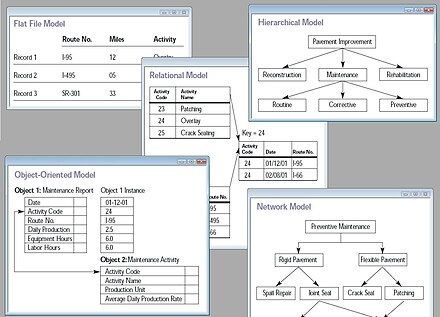
The foundations for modeling large sets of data were first introduced by Charles Bachman in 1969. Bachman introduced Data Structure Diagrams (DSDs) as a means to graphically represent data. DSDs provided a means to represent the relationships between different data entities. In 1970, Codd introduced the concept that users of a database should be ignorant of the “inner workings” of the database. Codd proposed the “relational view” of data which later evolved into the Relational Model which most databases use today. In 1971, the Database Task Report Group of CODASYL (the driving force behind the development of the programming language COBOL) first proposed a “data description language for describing a database, a data description language for describing that part of the data base known to a program, and a data manipulation language.” Most of the research and development of databases focused on the relational model during the 1970s.
In 1975 Bachman demonstrated how the relational model and the data structure set were similar and “congruent” ways of structuring data while working for Honeywell. The Entity-relationship model was first proposed in its current form by Peter Chen in 1976 while he was conducting research at MIT. This model became the most frequently used model to describe relational databases. Chen was able to propose a model that was superior to the navigational model and was more applicable to the “real world” than the relational model proposed by Codd.
Microsoft SQL Server Management Studio (SSMS) is a software application developed by Microsoft that is used for configuring, managing, and administering all components within Microsoft SQL Server. First launched with Microsoft SQL Server 2005, it is the successor to the Enterprise Manager in SQL 2000 or before. The tool includes both script editors and graphical tools which work with objects and features of the server.

A central feature of SSMS is the Object Explorer, which allows the user to browse, select, and act upon any of the objects within the server. It also shipped a separate Express edition that could be freely downloaded, however recent versions of SSMS are fully capable of connecting to and manage any SQL Server Express instance. Microsoft also incorporated backwards compatibility for older versions of SQL Server thus allowing a newer version of SSMS to connect to older versions of SQL Server instances. It also comes with Microsoft SQL Server Express 2012, or users can download it separately.
Starting from version 11, the application was based on the Visual Studio 2010 shell, using WPF for the user interface. Versions 18 and after are based on the Visual Studio 2017 Isolated Shell.
In June 2015, Microsoft announced their intention to release future versions of SSMS independently of SQL Server database engine releases.
On June 12, 1988, Microsoft joined Ashton-Tate was fighting for their desktop product dBASE while Sybase created a variant of Sybase SQL Server for IBM OS/2 (then developed jointly with Microsoft), which was released the following year. This was the first version of Microsoft SQL Server, and served as Microsoft’s entry to the enterprise-level database market, competing against Oracle, IBM, Informix, Ingres and later, Sybase. SQL Server 4.2 was shipped in 1992, bundled with OS/2 version 1.3, followed by version 4.21 for Windows NT, released alongside Windows NT 3.1. SQL Server 6.0 was the first version designed for NT, and did not include any direction from Sybase.
About the time Windows NT was released in July 1993, Sybase and Microsoft parted ways and each pursued its own design and marketing schemes. Microsoft negotiated exclusive rights to all versions of SQL Server written for Microsoft operating systems. (In 1996 Sybase changed the name of its product to Adaptive Server Enterprise to avoid confusion with Microsoft SQL Server.) Until 1994, Microsoft’s SQL Server carried three Sybase copyright notices as an indication of its origin.
SQL Server 7.0 was a major rewrite (C++) of the older Sybase engine, which was coded in C. Data pages were enlarged from 2k bytes to 8k bytes. Extents thereby grew from 16k bytes to 64k bytes. User Mode Scheduling (UMS) was introduced to handle SQL Server threads better than Windows preemptive multi-threading, also adding support for fibers (lightweight threads, introduced in NT 4.0, which are used to avoid context switching). SQL Server 7.0 also introduced a multi-dimensional database product called SQL OLAP Services (which became Analysis Services in SQL Server 2000). SQL Server 7.0 would be the last version to run on the DEC Alpha platform. Although there were pre-release versions of SQL 2000 (as well as Windows 2000) compiled for Alpha, these were canceled and were never commercially released. Mainstream Support Ended on December 31, 2005, as Extended Support Ended on January 11, 2011.