
Integrating application with Spring framework
COURTESY :- vrindawan.in
Wikipedia
The Spring Framework is an application framework and inversion of control container for the Java platform. The framework’s core features can be used by any Java application, but there are extensions for building web applications on top of the Java EE (Enterprise Edition) platform. Although the framework does not impose any specific programming model, it has become popular in the Java community as an addition to the Enterprise JavaBeans (EJB) model. The Spring Framework is open source.
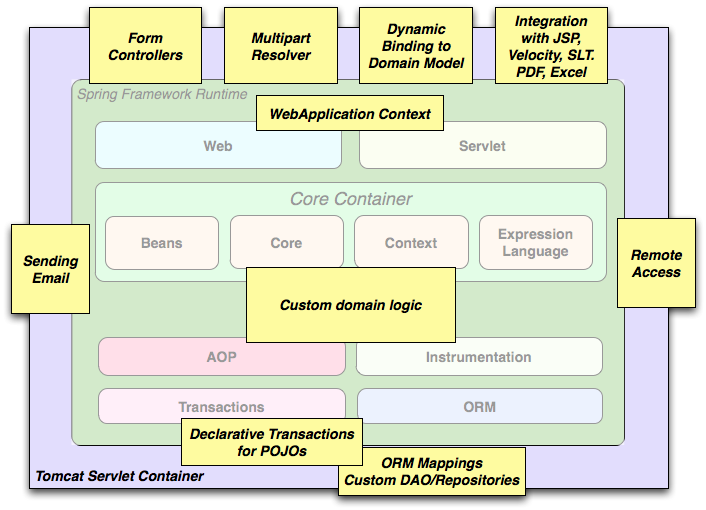
The first version was written by Rod Johnson, who released the framework with the publication of his book Expert One-on-One J2EE Design and Development in October 2002. The framework was first released under the Apache 2.0 license in June 2003. The first production release, 1.0, was released in March 2004. The Spring 1.2.6 framework won a Jolt productivity award and a JAX Innovation Award in 2006. Spring 2.0 was released in October 2006, Spring 2.5 in November 2007, Spring 3.0 in December 2009, Spring 3.1 in December 2011, and Spring 3.2.5 in November 2013. Spring Framework 4.0 was released in December 2013. Notable improvements in Spring 4.0 included support for Java SE (Standard Edition) 8, Groovy 2, some aspects of Java EE 7, and WebSocket.
Spring Boot 1.0 was released in April 2014.
Spring Framework 4.2.0 was released on 31 July 2015 and was immediately upgraded to version 4.2.1, which was released on 01 Sept 2015. It is “compatible with Java 6, 7 and 8, with a focus on core refinements and modern web capabilities”.
Spring Framework 4.3 has been released on 10 June 2016 and will be supported until 2020. It “will be the final generation within the general Spring 4 system requirements (Java 6+, Servlet 2.5+), […]”.
Spring 5 is announced to be built upon Reactive Streams compatible Reactor Core.
Central to the Spring Framework is its inversion of control (IoC) container, which provides a consistent means of configuring and managing Java objects using reflection. The container is responsible for managing object lifecycles of specific objects: creating these objects, calling their initialization methods, and configuring these objects by wiring them together.
Objects created by the container are also called managed objects or beans. The container can be configured by loading XML (Extensible Markup Language) files or detecting specific Java annotations on configuration classes. These data sources contain the bean definitions that provide the information required to create the beans.
Objects can be obtained by means of either dependency lookup or dependency injection. Dependency lookup is a pattern where a caller asks the container object for an object with a specific name or of a specific type. Dependency injection is a pattern where the container passes objects by name to other objects, via either constructors, properties, or factory methods.
In many cases one need not use the container when using other parts of the Spring Framework, although using it will likely make an application easier to configure and customize. The Spring container provides a consistent mechanism to configure applications and integrates with almost all Java environments, from small-scale applications to large enterprise applications.
The container can be turned into a partially compliant EJB (Enterprise JavaBeans) 3.0 container by means of the Pitchfork project. Some criticize the Spring Framework for not complying with standards. However, SpringSource doesn’t see EJB 3 compliance as a major goal, and claims that the Spring Framework and the container allow for more powerful programming models. The programmer does not directly create an object, but describes how it should be created, by defining it in the Spring configuration file. Similarly services and components are not called directly; instead a Spring configuration file defines which services and components must be called. This IoC is intended to increase the ease of maintenance and testing.