
Introduction to cloud computing Innovation
COURTESY :- vrindawan.in
Wikipedia
Cloud computing is the on-demand availability of computer system resources, especially data storage (cloud storage) and computing power, without direct active management by the user. Large clouds often have functions distributed over multiple locations, each of which is a data center. Cloud computing relies on sharing of resources to achieve coherence and typically uses a “pay-as-you-go” model, which can help in reducing capital expenses but may also lead to unexpected operating expenses for users.
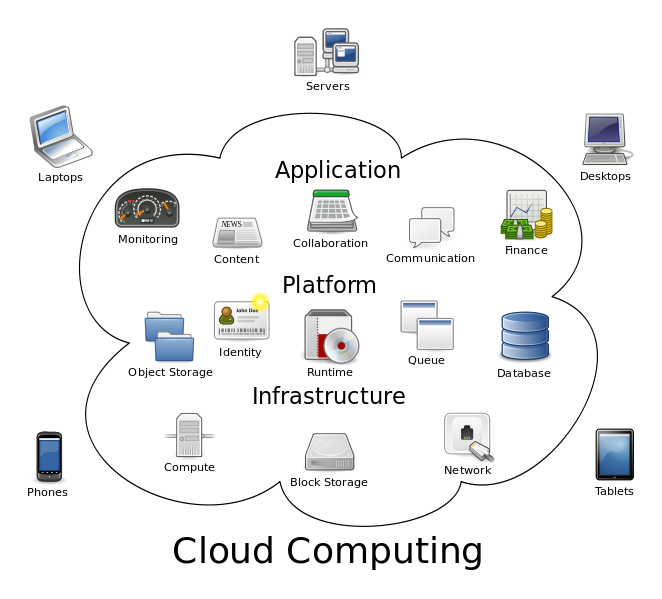
Advocates of public and hybrid clouds claim that cloud computing allows companies to avoid or minimize up-front IT infrastructure costs. Proponents also claim that cloud computing allows enterprises to get their applications up and running faster, with improved manageability and less maintenance, and that it enables IT teams to more rapidly adjust resources to meet fluctuating and unpredictable demand, providing burst computing capability: high computing power at certain periods of peak demand.
According to IDC, the global spending on cloud computing services has reached $706 billion and expected to reach $1.3 trillion by 2025. While Gartner estimated that the global public cloud services end-user spending forecast to reach $600 billion by 2023. As per McKinsey & Company report, cloud cost-optimization levers and value-oriented business use cases foresees more than $1 trillion in run-rate EBITDA across Fortune 500 companies as up for grabs in 2030. In 2022, more than $1.3 trillion in enterprise IT spending is at stake from the shift to cloud, growing to almost $1.8 trillion in 2025, according to Gartner.
The term cloud was used to refer to platforms for distributed computing as early as 1993, when Apple spin-off General Magic and AT&T used it in describing their (paired) Telescript and Personal Link technologies. In Wired’s April 1994 feature “Bill and Andy’s Excellent Adventure II”, Andy Hertzfeld commented on Telescript, General Magic’s distributed programming language:
“The beauty of Telescript … is that now, instead of just having a device to program, we now have the entire Cloud out there, where a single program can go and travel to many different sources of information and create a sort of a virtual service. No one had conceived that before. The example Jim White [the designer of Telescript, X.400 and ASN.1] uses now is a date-arranging service where a software agent goes to the flower store and orders flowers and then goes to the ticket shop and gets the tickets for the show, and everything is communicated to both parties.
During the 1960s, the initial concepts of time-sharing became popularized via RJE (Remote Job Entry); this terminology was mostly associated with large vendors such as IBM and DEC. Full-time-sharing solutions were available by the early 1970s on such platforms as Multics (on GE hardware), Cambridge CTSS, and the earliest UNIX ports (on DEC hardware). Yet, the “data center” model where users submitted jobs to operators to run on IBM’s mainframes was overwhelmingly predominant.
In the 1990s, telecommunications companies, who previously offered primarily dedicated point-to-point data circuits, began offering virtual private network (VPN) services with comparable quality of service, but at a lower cost. By switching traffic as they saw fit to balance server use, they could use overall network bandwidth more effectively. They began to use the cloud symbol to denote the demarcation point between what the provider was responsible for and what users were responsible for. Cloud computing extended this boundary to cover all servers as well as the network infrastructure. As computers became more diffused, scientists and technologists explored ways to make large-scale computing power available to more users through time-sharing. They experimented with algorithms to optimize the infrastructure, platform, and applications, to prioritize tasks to be executed by CPUs, and to increase efficiency for end users.
The use of the cloud metaphor for virtualized services dates at least to General Magic in 1994, where it was used to describe the universe of “places” that mobile agents in the Telescript environment could go. As described by Andy Hertzfeld:
“The beauty of Telescript,” says Andy, “is that now, instead of just having a device to program, we now have the entire Cloud out there, where a single program can go and travel to many different sources of information and create a sort of a virtual service.”
The use of the cloud metaphor is credited to General Magic communications employee David Hoffman, based on long-standing use in networking and telecom. In addition to use by General Magic itself, it was also used in promoting AT&T’s associated Persona Link Services.
In July 2002, Amazon created subsidiary Amazon Web Services, with the goal to “enable developers to build innovative and entrepreneurial applications on their own.” In March 2006 Amazon introduced its Simple Storage Service (S3), followed by Elastic Compute Cloud (EC2) in August of the same year. These products pioneered the usage of server virtualization to deliver IaaS at a cheaper and on-demand pricing basis.
In April 2008, Google released the beta version of Google App Engine. The App Engine was a PaaS (one of the first of its kind) which provided fully maintained infrastructure and a deployment platform for users to create web applications using common languages/technologies such as Python, Node.js and PHP. The goal was to eliminate the need for some administrative tasks typical of an IaaS model, while creating a platform where users could easily deploy such applications and scale them to demand.
In early 2008, NASA’s Nebula, enhanced in the RESERVOIR European Commission-funded project, became the first open-source software for deploying private and hybrid clouds, and for the federation of clouds.
By mid-2008, Gartner saw an opportunity for cloud computing “to shape the relationship among consumers of IT services, those who use IT services and those who sell them” and observed that “organizations are switching from company-owned hardware and software assets to per-use service-based models” so that the “projected shift to computing … will result in dramatic growth in IT products in some areas and significant reductions in other areas.
In 2008, the U.S. National Science Foundation began the Cluster Exploratory program to fund academic research using Google-IBM cluster technology to analyze massive amounts of data.
In 2009, the government of France announced Project Andro mède to create a “sovereign cloud” or national cloud computing, with the government to spend €285 million. The initiative failed badly and Cloud watt was shut down on 1 February 2020.