
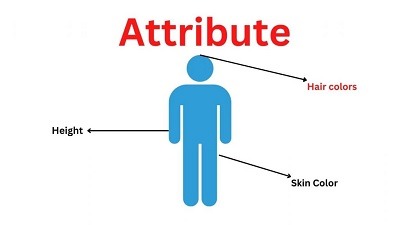
Attributes
Attributes refer to characteristics or features that define an object, entity, or individual. These attributes can be physical, qualitative, quantitative, or descriptive in nature. In various contexts, attributes play a significant role in identifying and understanding things. Here are some common types of attributes:
- Physical Attributes: These are tangible characteristics related to the appearance or composition of an object. For example, color, size, shape, weight, texture, and material are all physical attributes.
- Qualitative Attributes: These attributes are descriptive in nature and don’t have a specific numerical value. Examples include the taste of food, emotional states, or the quality of a product.
- Quantitative Attributes: Unlike qualitative attributes, these have measurable numerical values. For instance, age, height, temperature, and quantity are quantitative attributes.
- Categorical Attributes: Also known as nominal attributes, these represent different categories or groups. They don’t have any inherent order or numerical meaning. Examples include colors (red, blue, green), gender (male, female), or types of animals (dog, cat, bird).
- Ordinal Attributes: These attributes have categories with a specific order but no consistent numerical value. For example, educational levels (elementary, high school, college) or customer satisfaction levels (very dissatisfied, dissatisfied, neutral, satisfied, very satisfied) are ordinal attributes.
- Binary Attributes: These attributes have only two possible values. For instance, true/false, yes/no, or 1/0 are binary attributes.
- Temporal Attributes: These attributes relate to time and include information like date, time, or duration.
- Spatial Attributes: Spatial attributes provide information about the location or position of an object in space.
- Statistical Attributes: These attributes are derived from statistical analysis, such as mean, median, standard deviation, etc.
- Meta Attributes: Meta attributes describe other attributes. For example, the data type of an attribute (integer, string) or the unit of measurement (kilograms, meters) can be considered meta attributes.
In various fields like data science, databases, and artificial intelligence, understanding and handling attributes are essential for processing and analyzing information effectively.
What is required Attributes
“Required attributes” refer to attributes or fields that must be present and have valid values in a given context or data structure. These attributes are mandatory and cannot be left empty or null. They are essential for the proper functioning or understanding of the data or system they belong to.
The concept of required attributes is commonly encountered in databases, data modeling, programming, and form validation. Here are some examples in different contexts:
- Database Design: In a relational database, when creating a table, some attributes may be defined as “NOT NULL,” indicating that those attributes must have a value for each record. If a required attribute is left empty when inserting a new record, the database management system will typically raise an error.
- Form Validation: In web development, when designing a form for user input, certain fields may be marked as required. This means that the user must fill in those fields before submitting the form. The form validation process will check if the required fields have been filled, and if not, an error message will prompt the user to provide the necessary information.
- Data Modeling: When creating a data model, especially in entity-relationship diagrams, some attributes may be marked with a “crow’s foot” notation, indicating that they are required attributes for that entity.
For example, consider a simple “Employee” entity with attributes like “Employee ID,” “First Name,” “Last Name,” and “Date Of Birth.” The “Employee ID,” “First Name,” and “Last Name” attributes might be defined as required attributes because every employee record must have a unique ID, a first name, and a last name.
Required attributes help ensure data integrity, completeness, and accuracy in databases and other systems that handle data. They prevent the existence of records with missing essential information and enable more robust data processing and analysis.
Who is required attributes
As of my last update in September 2021, I’m not aware of any specific concept or entity called “required attributes.” It is possible that the term could be used in various contexts or domains, but without further context, it is difficult to provide a specific answer.
In some contexts, “required attributes” could refer to essential characteristics or properties that must be present for something to function properly or meet specific criteria. For example, in programming or data modeling, required attributes might refer to fields or properties that must have a value before a record can be saved in a database.
If you have a specific context or domain in mind, please provide more details so that I can give you a more accurate and relevant answer.
When is required Attributes
Based on your query, it seems there might be a slight misunderstanding in the phrasing. “Required attributes” doesn’t refer to a specific time, but rather it’s a concept used in various contexts to denote essential characteristics or properties that are mandatory or necessary for something to function properly or be considered valid.
Here are a few examples of where the term “required attributes” might be used:
- Data Validation: In data modeling or database design, required attributes are fields or properties that must have a value before a record can be saved. For instance, in a user registration form, the email address and password fields might be designated as required attributes, meaning the user must provide this information for successful registration.
- HTML Forms: When building web forms using HTML, you can specify certain form fields as “required.” This means that the user must fill in these fields before submitting the form.
- Software Development: In software development, certain attributes or parameters may be required for a function, method, or API call to work correctly. Without these required attributes, the function may throw an error or fail to execute as expected.
- Regulatory Compliance: In certain industries or fields, there may be regulations or standards that dictate certain attributes as required for compliance. For example, in financial transactions, specific pieces of information may be required to meet regulatory standards.
The concept of required attributes can be applied in various other domains and contexts as well, depending on the specific requirements and constraints of the situation at hand.
Where is required Attributes
Required attributes can be found and applied in various contexts and domains. Here are some common areas where required attributes are often used:
- Data Modeling and Databases: In database design, certain fields or columns in a table may be designated as required attributes. This means that when adding a new record to the table, values for these attributes must be provided, and they cannot be left empty or null.
- HTML Forms: When creating web forms using HTML, you can set certain form fields as “required.” This ensures that users must fill in these fields before submitting the form.
- Programming and Software Development: In software development, functions, methods, or APIs may have parameters or attributes that are marked as required. When calling these functions, the required attributes must be provided to ensure the function can execute correctly.
- Regulatory Compliance and Standards: In various industries, there may be regulations or standards that specify certain attributes as required for compliance. For instance, in healthcare, specific patient information might be required to adhere to privacy laws.
- Authentication and Security: When creating user accounts or setting up security measures, certain attributes, such as passwords or security questions, may be required to ensure the security of the system.
- Product Specifications and Certifications: In manufacturing and product development, certain attributes or features might be required to meet industry standards or certifications.
- Business Processes and Workflows: In business processes, certain attributes might be required at specific stages to ensure the process is completed accurately and efficiently.
The application of required attributes depends on the specific requirements and constraints of the system, application, or process being developed or used. It ensures that essential information is provided, leading to accurate and reliable outcomes.
How is required Attributes
Required attributes are typically implemented and enforced through rules, validations, or constraints depending on the context in which they are used. Here are some common ways how required attributes are handled:
- Data Modeling and Databases:
- When defining a database schema, certain columns can be marked as “NOT NULL,” meaning they must have a value for each record in the table.
- Database management systems may have built-in constraints or rules that enforce the requirement for specific attributes to be present when inserting or updating records.
- HTML Forms:
- In HTML, you can use the “required” attribute on form input elements to specify that the field must be filled before the form can be submitted. For example:
<input type="text" name="username" required>. - Modern web browsers automatically enforce this requirement and prevent form submission if required fields are left empty.
- In HTML, you can use the “required” attribute on form input elements to specify that the field must be filled before the form can be submitted. For example:
- Programming and Software Development:
- In programming languages, function parameters or method arguments can be defined as required. This means that when calling the function, the required attributes must be provided.
- Developers can manually check for the presence of required attributes within the function’s code and handle errors or exceptions if they are missing.
- Regulatory Compliance and Standards:
- Compliance with regulatory requirements often involves documentation and validation of specific attributes. Companies may have to adhere to strict rules to ensure compliance.
- Audits or inspections may be conducted to verify the presence of required attributes in relevant processes or records.
- Authentication and Security:
- During user registration or password setup, required attributes such as a unique username, password, or security questions must be provided.
- Security measures may enforce certain requirements for passwords, such as a minimum length, complexity, or expiration period.
- Product Specifications and Certifications:
- To obtain certifications or meet industry standards, products must possess certain attributes or features. Testing and validation processes may be employed to ensure compliance.
- Business Processes and Workflows:
- Required attributes can be specified at different stages of a business process, ensuring that all necessary information is collected and available to proceed to the next step.
Overall, the implementation of required attributes varies depending on the specific system, application, or domain. By enforcing these requirements, data integrity, user experience, and compliance can be maintained, contributing to the overall functionality and reliability of the system or process.
Case study on Attributes
Case Study: E-commerce Product Attributes Optimization
Background: A leading e-commerce company, “Tech Mart,” sells a wide range of electronic products through its online platform. The company’s success is heavily dependent on the quality of product information presented to customers. The product attributes, such as specifications, features, and descriptions, play a crucial role in attracting and retaining customers. However, Tech Mart is facing challenges related to inconsistent, incomplete, and poorly structured product attributes, which lead to customer dissatisfaction and decreased sales. They recognize the need to optimize their product attributes to enhance the user experience and improve conversion rates.
Objectives: Tech Mart aims to optimize product attributes to achieve the following objectives:
- Consistency: Ensure that product attributes are consistently formatted and presented across all product listings, improving clarity and user-friendliness.
- Completeness: Enrich product attributes by providing comprehensive and relevant information about each product, reducing customer uncertainty and the need for additional research.
- Relevance: Tailor attributes to match the specific needs and preferences of the target audience for each product category.
Implementation:
- Attribute Standardization:
- A team of data analysts and content editors is tasked with creating a standardized list of attributes for each product category. For example, for smartphones, standard attributes might include “Processor,” “RAM,” “Storage,” “Camera,” and “Battery.”
- Attribute Guidelines:
- Detailed guidelines are established to ensure that each attribute follows specific formatting rules. For instance, “Storage” should be expressed in gigabytes (GB) or terabytes (TB), and “Camera” should include resolution and features.
- Data Validation Tools:
- Data validation tools and algorithms are implemented to check for completeness and consistency of attributes. Automatic alerts are triggered if attributes are missing or deviate from the predefined guidelines.
- Attribute Enrichment:
- To enhance product descriptions, Tech Mart collaborates with product manufacturers and suppliers to obtain detailed and accurate attribute information. This ensures that the product attributes are up-to-date and reliable.
- User Feedback Integration:
- Tech Mart gathers feedback from customers regarding their shopping experiences, paying particular attention to attribute-related concerns. User feedback is used to continuously improve attribute accuracy and relevance.
- Dynamic Attribute Selection:
- For products with multiple variations, such as laptops with different configurations, Tech Mart dynamically selects and displays relevant attributes based on the user’s selection. This prevents overwhelming customers with unnecessary information.
Results:
After implementing the attributes optimization strategy, Tech Mart observes significant improvements in various key performance indicators:
- Conversion Rate: The conversion rate increases as customers have access to clear, comprehensive, and relevant product attributes, reducing hesitation and encouraging confident purchases.
- Customer Satisfaction: Users report higher satisfaction levels due to the improved clarity and consistency of product information.
- Reduced Returns: The number of product returns decreases as customers make more informed decisions based on accurate and complete attributes.
- SE O and Search Ranking: Optimized attributes positively impact search engine optimization, leading to better search rankings and increased organic traffic.
- Competitive Advantage: Tech Mart gains a competitive edge by offering superior product information compared to competitors with incomplete or inconsistent attributes.
Conclusion:
By focusing on optimizing product attributes, Tech Mart successfully improves the overall user experience, customer satisfaction, and business performance. The company’s commitment to providing accurate, complete, and relevant information helps build trust with customers, fostering loyalty and driving growth in the highly competitive e-commerce market. The continuous monitoring and improvement of attributes ensure that Tech Mart maintains its market leadership and customer-cent ric approach.
White paper on Attributes
Title: Understanding and Utilizing Attributes for Data Quality and Information Retrieval
Abstract: This white paper aims to provide a comprehensive overview of attributes and their significance in data management, information retrieval, and decision-making processes. Attributes, also known as features or variables, are essential components of datasets that describe the characteristics of entities or objects. Understanding how to effectively collect, manage, and utilize attributes is crucial for ensuring data quality, enabling accurate analyses, and supporting efficient information retrieval.
Table of Contents:
- Introduction 1.1 Definition of Attributes 1.2 Importance of Attributes in Data Management 1.3 Key Concepts and Terminologies
- Types of Attributes 2.1 Categorical Attributes 2.2 Numerical Attributes 2.3 Ordinal Attributes 2.4 Binary Attributes 2.5 Textual Attributes 2.6 Derived Attributes
- Data Collection and Attribute Design 3.1 Methods for Attribute Collection 3.2 Attribute Selection and Relevance 3.3 Handling Missing and Noisy Attributes 3.4 Impact of Data Skew ness on Attributes
- Attributes and Data Quality 4.1 Data Profiling and Attribute Validation 4.2 Data Cleaning and Attribute Standardization 4.3 Maintaining Data Integrity through Attributes 4.4 Monitoring Attribute Changes over Time
- Attributes and Information Retrieval 5.1 Attribute-Based Searching 5.2 Faceted Search and Navigation 5.3 Leveraging Metadata for Efficient Retrieval 5.4 Attributes in Re commender Systems
- Utilizing Attributes in Machine Learning 6.1 Feature Engineering and Attribute Transformation 6.2 Feature Importance and Selection 6.3 Attribute-Based Classifiers and Re gressors 6.4 Attributes for Explainable AI
- Attributes in Decision-Making and Business Intelligence 7.1 Attribute-Driven Analysis 7.2 Using Attributes in Decision Trees and Business Models 7.3 Enhancing Dashboards and Data Visualization with Attributes
- Challenges and Best Practices 8.1 Privacy and Ethical Considerations with Sensitive Attributes 8.2 Handling High-Dimensional Attribute Spaces 8.3 Dealing with Redundant and Correlated Attributes 8.4 Ensuring Attribute Consistency in Distributed Systems
- Case Studies 9.1 Improving Customer Segmentation with Attribute-Based Clustering 9.2 Utilizing Attribute-Based Search in E-commerce 9.3 Attribute-Driven Predictive Maintenance in Manufacturing
- Future Trends and Conclusions 10.1 Emerging Technologies and Attribute Management 10.2 The Role of Attributes in Artificial Intelligence and Big Data 10.3 Importance of Continuous Learning and Adaptability in Attribute Utilization
Conclusion: Attributes are fundamental building blocks in data management, analysis, and decision-making. Understanding their characteristics, ensuring data quality through proper validation and standardization, and leveraging them for information retrieval and machine learning tasks are critical steps toward making data-driven decisions and achieving meaningful insights. This white paper highlights the multifaceted nature of attributes and offers valuable insights into their optimal utilization in various domains, guiding organizations towards efficient data management and successful information retrieval.