
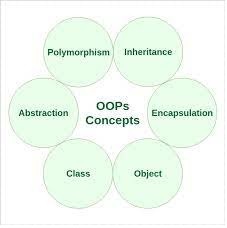
OOP Concepts
Object-Oriented Programming (OOP) is a programming paradigm that focuses on designing and organizing code using the concept of objects. Objects represent real-world entities or concepts and are used to model and structure the interactions and behaviors within a program. OOP promotes the principles of modularity, reusability, and maintainability. Here are the core concepts of OOP:
- Class: A class is a blueprint or template that defines the structure and behavior of an object. It encapsulates data (attributes) and methods (functions) that operate on that data. Objects are instances of classes.
- Object: An object is a concrete instance of a class. It represents a specific entity with its own data and behavior. Objects are created based on the class definition and can interact with each other.
- Encapsulation: Encapsulation involves bundling data (attributes) and the methods (functions) that operate on that data into a single unit, the class. This helps to control access to the internal state of an object, promoting information hiding and reducing unintended interference.
- Inheritance: Inheritance allows a class (subclass or derived class) to inherit properties and behaviors from another class (superclass or base class).
What is required OOP Concepts
To effectively apply Object-Oriented Programming (OOP) concepts, you need to understand and implement the following key concepts:
- Classes and Objects: Understand how to define classes, which serve as blueprints for creating objects. Classes encapsulate attributes (data) and methods (functions) that operate on the data. Objects are instances of classes, representing real-world entities or concepts.
- Encapsulation: Learn how to encapsulate data by making attributes private or protected and providing controlled access through getter and setter methods. This ensures that the internal state of an object remains consistent and secure.
- Inheritance: Master the concept of inheritance, where a new class (subclass or derived class) can inherit attributes and methods from an existing class (superclass or base class). Understand how to create hierarchical relationships between classes and leverage superclass features in subclasses.
- Polymorphism: Grasp the idea of polymorphism, which allows objects of different classes to be treated as instances of a common superclass. Understand method overriding and dynamic method binding to enable flexible and interchangeable behavior.
- Abstraction: Learn to abstract the essential features of objects and represent them in classes. Focus on relevant attributes and behaviors while hiding unnecessary complexities. Abstraction helps manage complexity and maintain a clear representation of entities.
- Association, Aggregation, and Composition: Understand the different types of relationships between classes: association (loose coupling), aggregation (part-whole relationship), and composition (stronger form of aggregation where parts are dependent on the whole).
- Interfaces and Abstract Classes: Know how to define interfaces (sets of method signatures) that classes can implement, providing a contract for behaviors. Learn about abstract classes, which can’t be instantiated but can serve as a basis for other classes.
- Design Principles (SOLID): Familiarize yourself with SOLID principles: Single Responsibility Principle (SRP), Open-Closed Principle (OCP), Liskov Substitution Principle (LSP), Interface Segregation Principle (ISP), and Dependency Inversion Principle (DIP). These principles guide software design for maintainability and scalability.
- Design Patterns: Study common design patterns like Factory, Singleton, Observer, Strategy, and more. Design patterns provide proven solutions to recurring design problems and help improve the organization and structure of your code.
- Testing and Refactoring: Learn how to write unit tests for your classes and methods. Refactoring, the process of improving code without changing its behavior, is a crucial skill to maintain code quality while accommodating changes and improvements.
- UML (Unified Modeling Language): Get familiar with UML diagrams, such as class diagrams, to visually represent the structure and relationships of classes and objects.
- Coding Practices: Adopt best practices for naming conventions, code organization, and documentation. This ensures your code is readable, maintainable, and understandable by others.
By mastering these concepts, you’ll be able to design and develop software using OOP principles effectively. Keep in mind that practice and practical application of these concepts in real-world projects are essential for gaining expertise in Object-Oriented Programming.
Who is required OOP Concepts
Object-Oriented Programming (OOP) concepts are required for software developers and programmers who want to design and build applications using object-oriented principles. These concepts provide a structured and organized way to model real-world entities and their interactions in code. Here are the primary OOP concepts that developers should be familiar with:
- Classes and Objects: Classes are blueprints or templates that define the structure and behavior of objects. Objects are instances of classes and represent real-world entities.
- Encapsulation: Encapsulation refers to the practice of bundling data (attributes) and methods (functions) that operate on that data into a single unit, known as a class. This helps in hiding the internal implementation details and exposing only the necessary interface.
- Inheritance: Inheritance allows a class (subclass or derived class) to inherit properties and behaviors from another class (superclass or base class). This promotes code reuse and hierarchy in the codebase.
- Polymorphism: Polymorphism allows objects of different classes to be treated as objects of a common base class. It enables the implementation of methods in multiple ways based on the specific class being used, enhancing flexibility and extensibility.
- Abstraction: Abstraction involves simplifying complex reality by modeling classes based on their essential attributes and behaviors. It allows developers to focus on relevant details while hiding unnecessary complexity.
- Method Overriding and Overloading: Method overriding involves redefining a method in a subclass to provide a specific implementation. Method overloading allows a class to have multiple methods with the same name but different parameters.
- Composition and Aggregation: Composition represents a “has-a” relationship between objects, where one object contains another as a part. Aggregation represents a similar
When is required OOP Concepts
Object-Oriented Programming (OOP) concepts are particularly beneficial and often necessary in various scenarios within software development. Here are some situations when OOP concepts are required or highly recommended:
- Large and Complex Applications: As applications grow in complexity, OOP helps manage the codebase by organizing it into manageable and reusable components. This prevents code
Where is required OOP Concepts
Object-Oriented Programming (OOP) concepts are required and beneficial in various domains and industries where software development is a fundamental part of the workflow. Here are some areas where OOP concepts are commonly applied:
- Software Development Industry: OOP is a foundational paradigm in the software development industry. It’s used in developing applications, systems, and software solutions across different platforms and technologies.
- Web Development: Many web applications and websites are built using OOP principles. Frameworks like Ruby on Rails, Django, and Laravel are based on OOP and help developers create scalable and maintainable web applications.
- Mobile App Development: OOP is widely used in mobile app development for both iOS (using Swift or Objective-C) and Android (using Java or Kotlin). Mobile apps often involve complex interactions and UI elements, which OOP helps model effectively.
- Game Development: Game development relies heavily on OOP concepts to manage various game entities, behaviors, and interactions. Game engines like Unity and Unreal Engine are built with OOP principles in mind.
- Desktop Applications: OOP is used to create graphical user interfaces (GUIs) and manage the underlying logic of desktop applications. Frameworks like JavaFX and Windows Presentation Foundation (WPF) are based on OOP.
- Embedded Systems: OOP can be applied in embedded systems programming, where hardware and software interactions need to be well-structured and organized.
- Scientific and Engineering Software: OOP is used to create software for simulations, modeling, data analysis, and scientific research, as it helps model complex real-world systems and interactions.
- Financial Software: OOP is used to design software for financial modeling, risk assessment, and trading systems, where complex calculations and data interactions are common.
- Healthcare and Medical Software: OOP is applied in medical software for patient record management, medical imaging, and diagnostic tools, where clear data modeling and interactions are crucial.
- Aerospace and Defense: OOP principles are used in developing software for aircraft systems, defense systems, and simulations to model various aspects of these complex systems.
- E-commerce: OOP is used in building e-commerce platforms to manage product catalogs, shopping carts, user interactions, and payment processing.
- Content Management Systems (CMS): OOP is applied in creating CMS platforms like WordPress, Drupal, and Joomla, which require structured management of content, plugins, and themes.
- IoT (Internet of Things): OOP can be used to develop software for IoT devices, where interactions between connected devices need to be well-organized.
- Educational Software: OOP is used in creating educational software and e-learning platforms, where structured course materials and interactions are necessary.
- Artificial Intelligence and Machine Learning: OOP is often used in the development of AI and machine learning algorithms, as well as in creating software to manage and analyze large datasets.
These are just a few examples, and the list is not exhaustive. OOP concepts are versatile and applicable in various industries and domains where software development plays a role in creating solutions to real-world problems.
How is required OOP Concepts
The application of Object-Oriented Programming (OOP) concepts depends on the specific problem you’re trying to solve and the software you’re developing. Here’s how OOP concepts are typically applied:
- Identify Objects and Classes: Begin by identifying the main objects or entities in your problem domain. These objects will become the building blocks of your classes. For example, in a library management system, objects could include books, patrons, and librarians.
- Abstraction: Abstract the characteristics (attributes) and behaviors (methods) of these objects. Attributes represent the properties of an object, while methods represent its actions or behaviors. For a “Car” object, attributes might include “color,” “make,” and “model,” while methods could be “start Engine” and “drive.”
- Class Definition: Create class definitions based on the identified objects. Classes encapsulate attributes and methods that define the behavior and properties of the objects. For instance, the “Book” class might have attributes like “title” and “author,” along with methods like “borrow” and “return.”
- Encapsulation: Encapsulate the data (attributes) within the class and control access to it using access modifiers like public, private, and protected. This ensures that data is accessed and modified through well-defined methods, promoting data integrity and security.
- Inheritance: Use inheritance to create specialized classes (subclasses) based on existing classes (superclasses). This promotes code reuse and allows you to add or modify behavior in a controlled manner. For example, a “Student” class could inherit from a more general “Person” class.
- Polymorphism: Utilize polymorphism to allow objects of different classes to be treated as objects of a common superclass. This enables you to write more generic code that can work with different types of objects. For instance, both “Book” and “DVD” objects could have a common “checkout” method.
- Object Creation: Instantiate objects based on class definitions. Objects represent individual
White paper on OOP Concepts
A white paper on Object-Oriented Programming (OOP) concepts can provide a comprehensive overview of the principles and benefits of OOP, along with examples and practical applications. Below is an outline of what a white paper on OOP concepts might cover:
Title: Understanding Object-Oriented Programming Concepts
1. Introduction
- Brief explanation of the purpose and significance of OOP.
- Historical context and evolution of OOP.
2. Fundamentals of Object-Oriented Programming
- Definition of OOP and its core principles.
- Comparison with other programming paradigms.
- Importance of modeling real-world entities in software.
3. Key OOP Concepts
3.1. Classes and Objects
- Definition of classes and objects.
- Relationship between classes and objects.
- The concept of instantiation.
3.2. Abstraction
- Explanation of abstraction and its role in simplifying complexity.
- Creating abstract representations of real-world entities.
3.3. Encapsulation
- Definition of encapsulation and information hiding.
- Advantages of encapsulating data and behavior within classes.
3.4. Inheritance
- Explanation of inheritance and its purpose.
- Types of inheritance (single, multiple, multilevel, hierarchical).
- Reusing code through subclassing.
3.5. Polymorphism
- Definition of polymorphism and its importance.
- Types of polymorphism (compile-time and runtime).
- Implementing polymorphism using interfaces and abstract classes.
4. Practical Applications of OOP
4.1. Software Development
- Benefits of using OOP for designing complex software systems.
- Creation of modular, reusable, and maintainable code.
4.2. Real-World Modeling
- How OOP helps in modeling real-world entities and interactions.
- Examples from domains such as finance, healthcare, and manufacturing.
4.3. Code Reusability
- Illustration of code reusability using inheritance and interfaces.
- Designing frameworks and libraries with OOP principles.
4.4. Collaborative Development
- OOP’s role in enabling collaborative software development.
- Separation of concerns and distributed development teams.
5. Case Studies
5.1. Banking System
- Detailed example of modeling a banking system using OOP concepts.
- Implementation of classes, encapsulation, and inheritance.
5.2. E-commerce Platform
- Case study demonstrating OOP in building an e-commerce application.
- Utilizing classes to represent products, customers, and orders.
6. Challenges and Best Practices
6.1. Common Pitfalls
- Identification of common mistakes in implementing OOP concepts.
- Addressing issues related to overuse or misuse of inheritance.
6.2. Design Patterns
- Introduction to design patterns as solutions to recurring design problems.
- Examples of design patterns based on OOP concepts (Factory, Observer, Singleton).