
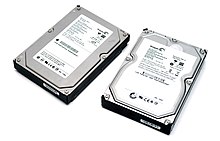
White Paper on Hard Disk (SATA, USB, Solid State)
COURTESY :- vrindawan.in
Wikipedia
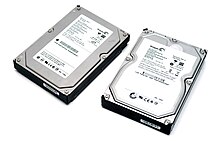
A hard disk drive (HDD), hard disk, hard drive, or fixed disk is an electro-mechanical data storage device that stores and retrieves digital data using magnetic storage with one or more rigid rapidly rotating platters coated with magnetic material. The platters are paired with magnetic heads, usually arranged on a moving actuator arm, which read and write data to the platter surfaces. Data is accessed in a random-access manner, meaning that individual blocks of data can be stored and retrieved in any order. HDDs are a type of non-volatile storage, retaining stored data when powered off. Modern HDDs are typically in the form of a small rectangular box.
Introduced by IBM in 1956, HDDs were the dominant secondary storage device for general-purpose computers beginning in the early 1960s. HDDs maintained this position into the modern era of servers and personal computers, though personal computing devices produced in large volume, like cell phones and tablets, rely on flash memory storage devices. More than 224 companies have produced HDDs historically, though after extensive industry consolidation most units are manufactured by Seagate, Toshiba, and Western Digital. HDDs dominate the volume of storage produced (exabytes per year) for servers. Though production is growing slowly (by exabytes shipped), sales revenues and unit shipments are declining because solid-state drives (SSDs) have higher data-transfer rates, higher areal storage density, somewhat better reliability, and much lower latency and access times.
The revenues for SSDs, most of which use NAND flash memory, slightly exceeded those for HDDs in 2018. Flash storage products had more than twice the revenue of hard disk drives as of 2017. Though SSDs have four to nine times higher cost per bit, they are replacing HDDs in applications where speed, power consumption, small size, high capacity and durability are important. As of 2019, the cost per bit of SSDs is falling, and the price premium over HDDs has narrowed.
The primary characteristics of an HDD are its capacity and performance. Capacity is specified in unit prefixes corresponding to powers of 1000: a 1-terabyte (TB) drive has a capacity of 1,000 gigabytes (GB; where 1 gigabyte = 1 billion (109) bytes). Typically, some of an HDD’s capacity is unavailable to the user because it is used by the file system and the computer operating system, and possibly inbuilt redundancy for error correction and recovery. There can be confusion regarding storage capacity, since capacities are stated in decimal gigabytes (powers of 1000) by HDD manufacturers, whereas the most commonly used operating systems report capacities in powers of 1024, which results in a smaller number than advertised. Performance is specified as the time required to move the heads to a track or cylinder (average access time), the time it takes for the desired sector to move under the head (average latency, which is a function of the physical rotational speed in revolutions per minute), and finally the speed at which the data is transmitted (data rate).
The two most common form factors for modern HDDs are 3.5-inch, for desktop computers, and 2.5-inch, primarily for laptops. HDDs are connected to systems by standard interface cables such as PATA (Parallel ATA), SATA (Serial ATA), USB or SAS (Serial Attached SCSI) cables.
The first production IBM hard disk drive, the 350 disk storage, shipped in 1957 as a component of the IBM 305 RAMAC system. It was approximately the size of two medium-sized refrigerators and stored five million six-bit characters (3.75 megabytes) on a stack of 52 disks (100 surfaces used). The 350 had a single arm with two read/write heads, one facing up and the other down, that moved both horizontally between a pair of adjacent platters and vertically from one pair of platters to a second set. Variants of the IBM 350 were the IBM 355, IBM 7300 and IBM 1405.
In 1961 IBM announced, and in 1962 shipped, the IBM 1301 disk storage unit, which superseded the IBM 350 and similar drives. The 1301 consisted of one (for Model 1) or two (for model 2) modules, each containing 25 platters, each platter about 1⁄8-inch (3.2 mm) thick and 24 inches (610 mm) in diameter. While the earlier IBM disk drives used only two read/write heads per arm, the 1301 used an array of 48 heads (comb), each array moving horizontally as a single unit, one head per surface used. Cylinder-mode read/write operations were supported, and the heads flew about 250 micro-inches (about 6 µm) above the platter surface. Motion of the head array depended upon a binary adder system of hydraulic actuators which assured repeatable positioning. The 1301 cabinet was about the size of three home refrigerators placed side by side, storing the equivalent of about 21 million eight-bit bytes per module. Access time was about a quarter of a second.
Also in 1962, IBM introduced the model 1311 disk drive, which was about the size of a washing machine and stored two million characters on a removable disk pack. Users could buy additional packs and interchange them as needed, much like reels of magnetic tape. Later models of removable pack drives, from IBM and others, became the norm in most computer installations and reached capacities of 300 megabytes by the early 1980s. Non-removable HDDs were called “fixed disk” drives.
In 1963 IBM introduced the 1302, with twice the track capacity and twice as many tracks per cylinder as the 1301. The 1302 had one (for Model 1) or two (for Model 2) modules, each containing a separate comb for the first 250 tracks and the last 250 tracks.
Some high-performance HDDs were manufactured with one head per track, e.g., Burroughs B-475 in 1964, IBM 2305 in 1970, so that no time was lost physically moving the heads to a track and the only latency was the time for the desired block of data to rotate into position under the head. Known as fixed-head or head-per-track disk drives, they were very expensive and are no longer in production.
In 1973, IBM introduced a new type of HDD code-named “Winchester”. Its primary distinguishing feature was that the disk heads were not withdrawn completely from the stack of disk platters when the drive was powered down. Instead, the heads were allowed to “land” on a special area of the disk surface upon spin-down, “taking off” again when the disk was later powered on. This greatly reduced the cost of the head actuator mechanism, but precluded removing just the disks from the drive as was done with the disk packs of the day. Instead, the first models of “Winchester technology” drives featured a removable disk module, which included both the disk pack and the head assembly, leaving the actuator motor in the drive upon removal. Later “Winchester” drives abandoned the removable media concept and returned to non-removable platters.
In 1974 IBM introduced the swinging arm actuator, made feasible because the Winchester recording heads function well when skewed to the recorded tracks. The simple design of the IBM GV (Gulliver) drive, invented at IBM’s UK Hursley Labs, became IBM’s most licensed electro-mechanical invention of all time, the actuator and filtration system being adopted in the 1980s eventually for all HDDs, and still universal nearly 40 years and 10 Billion arms later.
Like the first removable pack drive, the first “Winchester” drives used platters 14 inches (360 mm) in diameter. In 1978 IBM introduced a swing arm drive, the IBM 0680 (Piccolo), with eight inch platters, exploring the possibility that smaller platters might offer advantages. Other eight inch drives followed, then 5+1⁄4 in (130 mm) drives, sized to replace the contemporary floppy disk drives. The latter were primarily intended for the then fledgling personal computer (PC) market.
Over time, as recording densities were greatly increased, further reductions in disk diameter to 3.5″ and 2.5″ were found to be optimum. Powerful rare earth magnet materials became affordable during this period, and were complementary to the swing arm actuator design to make possible the compact form factors of modern HDDs.
As the 1980s began, HDDs were a rare and very expensive additional feature in PCs, but by the late 1980s their cost had been reduced to the point where they were standard on all but the cheapest computers.
Most HDDs in the early 1980s were sold to PC end users as an external, add-on subsystem. The subsystem was not sold under the drive manufacturer’s name but under the subsystem manufacturer’s name such as Corvus Systems and Tall grass Technologies, or under the PC system manufacturer’s name such as the Apple ProFile. The IBM PC/XT in 1983 included an internal 10 MB HDD, and soon thereafter internal HDDs proliferated on personal computers.
External HDDs remained popular for much longer on the Apple Macintosh. Many Macintosh computers made between 1986 and 1998 featured a SCSI port on the back, making external expansion simple. Older compact Macintosh computers did not have user-accessible hard drive bays (indeed, the Macintosh 128K, Macintosh 512K, and Macintosh Plus did not feature a hard drive bay at all), so on those models external SCSI disks were the only reasonable option for expanding upon any internal storage.
HDD improvements have been driven by increasing areal density, listed in the table above. Applications expanded through the 2000s, from the mainframe computers of the late 1950s to most mass storage applications including computers and consumer applications such as storage of entertainment content.
In the 2000s and 2010s, NAND began supplanting HDDs in applications requiring portability or high performance. NAND performance is improving faster than HDDs, and applications for HDDs are eroding. In 2018, the largest hard drive had a capacity of 15 TB, while the largest capacity SSD had a capacity of 100 TB. As of 2018, HDDs were forecast to reach 100 TB capacities around 2025, but as of 2019 the expected pace of improvement was pared back to 50 TB by 2026. Smaller form factors, 1.8-inches and below, were discontinued around 2010. The cost of solid-state storage (NAND), represented by Moore’s law, is improving faster than HDDs. NAND has a higher price elasticity of demand than HDDs, and this drives market growth. During the late 2000s and 2010s, the product life cycle of HDDs entered a mature phase, and slowing sales may indicate the onset of the declining phase.
The 2011 Thailand floods damaged the manufacturing plants and impacted hard disk drive cost adversely between 2011 and 2013.
In 2019, Western Digital closed its last Malaysian HDD factory due to decreasing demand, to focus on SSD production. All three remaining HDD manufacturers have had decreasing demand for their HDDs since 2014.
A modern HDD records data by magnetizing a thin film of ferromagnetic material on both sides of a disk. Sequential changes in the direction of magnetization represent binary data bits. The data is read from the disk by detecting the transitions in magnetization. User data is encoded using an encoding scheme, such as run-length limited encoding, which determines how the data is represented by the magnetic transitions.
Serial ATA (SATA, abbreviated from Serial AT Attachment) is a computer bus interface that connects host bus adapters to mass storage devices such as hard disk drives, optical drives, and solid-state drives. Serial ATA succeeded the earlier Parallel ATA (PATA) standard to become the predominant interface for storage devices.

Serial ATA industry compatibility specifications originate from the Serial ATA International Organization (SATA-IO) which are then promulgated by the INCITS Technical Committee T13, AT Attachment (INCITS T13).
SATA was announced in 2000 in order to provide several advantages over the earlier PATA interface such as reduced cable size and cost (seven conductors instead of 40 or 80), native hot swapping, faster data transfer through higher signaling rates, and more efficient transfer through an (optional) I/O queuing protocol. Revision 1.0 of the specification was released in January 2003.
Serial ATA industry compatibility specifications originate from the Serial ATA International Organization (SATA-IO). The SATA-IO group collaboratively creates, reviews, ratifies, and publishes the interoperability specifications, the test cases and plugfests. As with many other industry compatibility standards, the SATA content ownership is transferred to other industry bodies: primarily INCITS T13 and an INCITS T10 subcommittee (SCSI), a subgroup of T10 responsible for Serial Attached SCSI (SAS). The remainder of this article strives to use the SATA-IO terminology and specifications.
Before SATA’s introduction in 2000, PATA was simply known as ATA. The “AT Attachment” (ATA) name originated after the 1984 release of the IBM Personal Computer AT, more commonly known as the IBM AT. The IBM AT’s controller interface became a de facto industry interface for the inclusion of hard disks. “AT” was IBM’s abbreviation for “Advanced Technology”; thus, many companies and organizations indicate SATA is an abbreviation of “Serial Advanced Technology Attachment”. However, the ATA specifications simply use the name “AT Attachment”, to avoid possible trademark issues with IBM.
SATA host adapters and devices communicate via a high-speed serial cable over two pairs of conductors. In contrast, parallel ATA (the redesignation for the legacy ATA specifications) uses a 16-bit wide data bus with many additional support and control signals, all operating at a much lower frequency. To ensure backward compatibility with legacy ATA software and applications, SATA uses the same basic ATA and ATAPI command sets as legacy ATA devices.
The world’s first SATA hard disk drive is the Sea gate Barracuda SATA V, which was released in Jan 2003.
SATA has replaced parallel ATA in consumer desktop and laptop computers; SATA’s market share in the desktop PC market was 99% in 2008. PATA has mostly been replaced by SATA for any use; with PATA in declining use in industrial and embedded applications that use Compact Flash (CF) storage, which was designed around the legacy PATA standard. A 2008 standard, CFast, to replace Compact Flash is based on SATA.
The Serial ATA spec requires SATA devices be capable of hot plugging; that is, devices that meet the specification are capable of insertion or removal of a device into or from a backplane connector (combined signal and power) that has power on. After insertion, the device initializes and then operates normally. Depending upon the operating system, the host may also initialize, resulting in a hot swap. The powered host and device do not need to be in an idle state for safe insertion and removal, although unwritten data may be lost when power is removed.
Unlike PATA, both SATA and eSATA support hot plugging by design. However, this feature requires proper support at the host, device (drive), and operating-system levels. In general, SATA devices fulfill the device-side hot-plugging requirements, and most SATA host adapters support this function.
For eSATA, hot plugging is supported in AHCI mode only. IDE mode does not support hot plugging.