
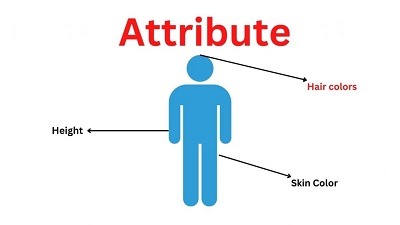
Attributes
In various contexts, the term “attributes” can refer to different things. Here are a few common meanings of the term:
- Database Management:
- In the context of database management, an attribute refers to a characteristic or property of a database entity. For example, in a database table for storing information about employees, attributes could include “employee ID,” “name,” “job title,” and “salary.”
- Programming and Software Development:
- In programming and software development, an attribute is a characteristic or property of an object. In object-oriented programming, objects have attributes that define their state. For instance, a “Car” object might have attributes like “color,” “model,” and “year.”
- HTML and Web Development:
- In HTML (Hypertext Markup Language) and web development, attributes are used to provide additional information about HTML elements. For example, the
<img>element may have attributes such as “src” (source) and “alt” (alternate text).
- In HTML (Hypertext Markup Language) and web development, attributes are used to provide additional information about HTML elements. For example, the
- Statistical Analysis and Data Science:
- In statistics and data science, attributes are often synonymous with variables. For instance, in a dataset, each column represents a variable or attribute, and each row represents an observation or data point.
- Machine Learning:
- In machine learning, attributes are the features or variables used to describe and characterize the data. These attributes are input into a machine learning model to make predictions or classifications.
- XML (eXtensible Markup Language):
- Similar to HTML, XML uses attributes to provide additional information about elements. For example, has attributes specifying the title and author of a book.
- Mathematics:
- In mathematics, attributes can refer to the characteristics or properties of mathematical objects. For instance, in geometry, attributes of a shape might include its area, perimeter, and angles.
- User Interface (UI) Design:
- In UI design, attributes can refer to the characteristics of visual elements, such as the color, size, or font of a text element.
In summary, the term “attributes” takes on different meanings depending on the context in which it is used. It generally refers to characteristics, properties, or features associated with entities, objects, or elements in various fields such as databases, programming, statistics, and design.
The requirements for attributes depend on the context in which the term is used. Here are common scenarios where attributes have specific requirements:
- Database Design:
- Requirements: In the context of database design, attributes are the properties of entities. Requirements include defining the type, length, and constraints (such as uniqueness or nullability) for each attribute. Clear specifications ensure data integrity and accuracy.
- Programming and Object-Oriented Design:
- Requirements: In programming, attributes of objects should be defined based on the data they need to store. Requirements include specifying the data type, access control (public, private, etc.), and any constraints or validations. Well-defined attributes contribute to code clarity and maintainability.
- HTML and Web Development:
- Requirements: HTML attributes provide additional information about elements. Requirements include understanding the purpose of each attribute, adhering to syntax rules, and ensuring compatibility with browsers. Proper use of attributes enhances the functionality and appearance of web pages.
- Statistical Analysis and Data Science:
- Requirements: In statistical analysis and data science, attributes represent variables. Requirements include selecting relevant attributes for analysis, ensuring data quality, handling missing values, and preparing data for modeling. Properly chosen attributes contribute to the accuracy of statistical analyses and machine learning models.
- Machine Learning:
- Requirements: Attributes in machine learning are features used for predictions. Requirements include selecting relevant features, handling categorical variables, and normalizing or scaling data. Properly engineered attributes are essential for building effective machine learning models.
- XML and Markup Languages:
- Requirements: In XML, attributes provide additional information about elements. Requirements include following XML syntax rules, specifying attribute values appropriately, and ensuring interoperability with other systems. Well-defined attributes support data interchange and interoperability.
- User Interface (UI) Design:
- Requirements: UI design attributes include visual characteristics such as color, size, and font. Requirements involve aligning attributes with the overall design principles, ensuring accessibility, and considering user experience. Thoughtful attribute design enhances the usability and aesthetics of the interface.
- Mathematics:
- Requirements: In mathematical contexts, attributes are characteristics of mathematical objects. Requirements may include defining measurement units, ensuring consistency in notation, and specifying relationships between attributes. Clear requirements aid in mathematical clarity and precision.
In all these contexts, the requirements for attributes revolve around clarity, consistency, and appropriateness for their intended purpose. Defining attributes with clear specifications ensures that they serve their intended function, whether in data storage, programming, web development, statistical analysis, or other fields.